


Brands treat retail media as a single channel instead of three separate strategic decisions layered on top of each other: which networks to fund, how to allocate budget across the funnel, and how to measure results. This brief lays out a practical framework for choosing networks, allocating budget, and building the measurement infrastructure that ties spend to incremental sales, not just reported ROAS.
It is written for brand marketers, media buyers, and retail media leads already running campaigns on one or more retail media networks (RMNs) who need a repeatable model for scaling decisions, not a primer on what retail media is.
Key Highlights
- Correct network selection, budget allocation, and measurement infrastructure give brands a repeatable framework instead of ad hoc, network-by-network decisions.
- Retail media budgets remain concentrated in two walled gardens even though physical retail still drives more than 80% of US commerce; in-store and DOOH are the most underused layers of the stack.
- ROAS alone cannot prove incrementality; it cannot distinguish a sale the ad caused from a sale that would have happened anyway.
- Standardizing measurement definitions across networks (attribution windows, new-to-brand rules) matters as much as the media buy itself.
The 3-Layer Retail Media Advertising Strategy Stack
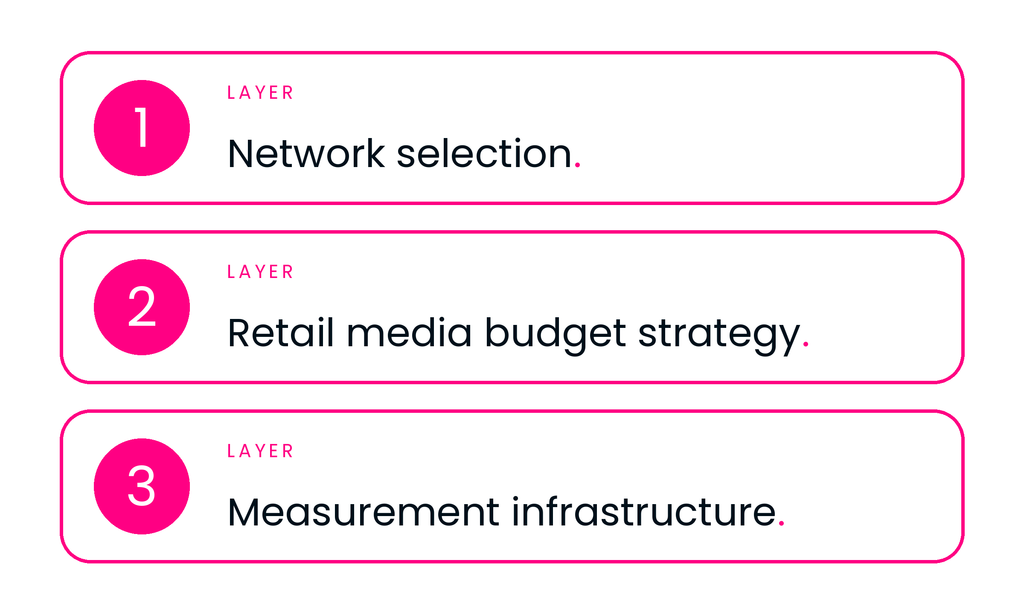
Each layer depends on the other two. The right networks don't matter if the budget is split wrong. And a well-planned budget is wasted if you can't measure whether it worked. Each layer is also a separate decision, usually made by a different person, on a different schedule:
- Layer 1: Network Selection - the retail media networks and formats (on-site, off-site, in-store) that actually reach your buyers.
- Layer 2: Retail Media Budget Strategy - how much to allocate, and where, across the funnel and the calendar.
- Layer 3: Measurement Infrastructure - how you prove incrementality, not just in ROAS, across every network in the mix.
Layer 1: Choosing the Right Retail Media Networks
A retail media network's real value is the first-party audience behind it; the network is just the wrapper. Before funding a new network, confirm it can prove three things: who it reaches, whether that audience overlaps with your target buyers, and whether it will hand you clean data to measure incrementality later.
On-Site, Off-Site, and In-Store: A Business Decision, Not a Format Decision
Treating on-site, off-site, and in-store as interchangeable retail media formats is the fastest way to misallocate budget. They answer different questions:
- On-site (sponsored products, search) captures demand at the moment of purchase intent.
- Off-site (display, video, DOOH run against a retailer's first-party audience away from its own property) builds the demand that shows up on-site later.
- In-store reaches more than 80% of US retail commerce that still happens in a physical location - a share large enough that Perion acquired PRN, a leading in-store retail media company with exclusive, multi-year agreements across warehouse club, big-box, and healthcare retail, to close that gap for its clients.
Perion's partnership with Albertsons Media Collective is a useful reference point for what off-site depth looks like in practice. It gives advertisers access to Albertsons' purchase-based first-party audiences, more than 2,200 store locations, 37 million weekly shoppers, and over 100 million addressable digital IDs, activated through high-impact display and DOOH, with closed-loop measurement built in from the start.
“Our partnership brings together the three pillars marketers are demanding today: high-quality audience data, engaging ad formats and measurable outcomes.” — Evan Hovorka, VP of Product Innovation, Albertsons Media Collective
The business decision is not “which format performs best”; it's “which combination of on-site, off-site, and in-store matches how our category is actually purchased.” A CPG brand sold almost entirely in physical stores needs a very different mix than a DTC brand that converts on-site.
See how Perion connects off-site, DOOH, and in-store retail media under one execution layer. Request a demo.
How to Score and Select Retail Media Advertising Networks
Score every retail media network on the same criteria before committing budget, so decisions stay comparable across a portfolio that, for most brands, already spans six or more networks a year.
| Criterion | What to Evaluate | Why It Matters |
|---|---|---|
| Audience overlap | How closely the network's shoppers match your target buyers | Reach without relevance inflates impressions |
| First-party data quality | Verified purchase data (receipts, loyalty, SKU-level) vs. inferred behavior | Sharper targeting and cleaner incrementality reads |
| Measurement transparency | Raw performance data vs. a dashboard summary only | Can't standardize measurement if the network's a black box |
| Self-serve capabilities | Direct campaign control vs. managed service only | Managed-service-only slows down mid-flight changes |
| Category fit | How well the retailer's shopper base fits your category | A home-improvement retailer's audience won't help you sell beauty products |
| Inventory depth | Whether the network offers on-site, off-site, and in-store/DOOH formats, or on-site only | Single-format networks force you to patch the rest of the funnel elsewhere |
| Cross-channel interoperability | Whether data and creative plug into your wider stack (CTV, DOOH, social) | Siloed networks recreate the exact reporting fragmentation Layer 3 is meant to solve |
Layer 2: Retail Media Advertising Budget Strategy: Where to Invest and Why
Budget strategy in retail media is a two-axis decision: how much goes to each stage of the funnel, and how that allocation shifts across the calendar. Get either axis wrong, and Layer 1 stops mattering.
The Full-Funnel Budget Framework
Retail media budgets lean heavily toward the bottom of the funnel (sponsored search and on-site placements) because attribution is easiest there. This is why so many retail media programs hit a ceiling: bottom-funnel formats only capture existing demand; they can't create it. A full-funnel allocation instead puts:
- Upper-funnel spend (DOOH, CTV, off-site display) toward building the demand that shows up as branded search next quarter.
- Mid-funnel spend (retargeting display, sponsored brands) toward moving shoppers from awareness to consideration.
- Lower-funnel spend (sponsored products, on-site search) toward capturing the demand the first two layers created.
Perion's Predictive Planning tools model expected performance before a campaign launches, so this split can be sized against forecasted lift instead of last year's budget ratio.

Seasonal Budget Strategy
Retail media demand fluctuates constantly, and the budget should change with it. For example, grocery and CPG categories see in-store and DOOH spikes around holidays, and purchase timing can shift before most annual budgets can react. Perion's analysis of the back-to-school season found that consumer spending had already moved earlier in the calendar while ad budgets largely hadn't.
To avoid this mismatch, build flexibility into the budget: hold back a portion of Layer 2 spend at the start of each quarter. Once the season is underway, funds can shift to whichever network or format shows incremental lift, instead of locking in a plan made months in advance.
Perion's own campaign data shows what that flexibility can do. In an Albertsons Media Collective campaign for Primo Water, Perion ran DOOH across transit hubs, gyms, and offices from April to May 2025 and used mid-flight optimization to focus delivery on high-performing stores. The campaign delivered a 5.5% incremental sales lift on 5.5 million impressions.
Layer 3: Retail Media Advertising Measurement Strategy: Where to Look and What to Track
Layer 3 isn't about which metrics to track; it defines your measurement infrastructure: which systems, cadences, and standards make those metrics trustworthy across every network.
We cover the full metric-by-metric breakdown (iROAS, new-to-brand rate, share of voice, customer lifetime value) in Retail Media Analytics: How to Measure Incrementality & Impact.
Three-Metric Measurement Pillars Every Retail Media Strategy Needs
No single metric proves a retail media strategy is working, but the three below, read together, do.
| Metric | What It Measures | What It Can't Tell You Separately |
|---|---|---|
| ROAS | Gross revenue generated per dollar of media spend, network by network | Whether that revenue was incremental or would have happened anyway |
| Incrementality | The lift in sales directly attributable to the campaign, isolating organic demand | Whether that lift was efficient relative to what you spent to get it |
| Share of Voice (SOV) | Your brand's visible presence relative to competitors within a retailer's search results, category pages, or DOOH network | Whether that visibility is converting into sales |
How Often Should You Review Your Retail Media Advertising Results?
Review cadence should match how fast your underlying data updates:
- Pacing and delivery: weekly, at minimum, across every network.
- Incrementality reads: monthly, once enough conversion volume has accumulated to be meaningful.
- Full network-mix rebalancing (moving Layer 2 budget based on what Layer 3 is showing): quarterly.
Perion's partnership with Fetch (via LiveRamp) shows what this infrastructure looks like in practice. It gives advertisers access to verified, SKU-level purchase data from over 13 million monthly active users and 13 million daily receipts across 26,000+ merchants. Deterministic data at this level closes the gap between 'a sale happened' and 'we can attribute it', making monthly incrementality reads realistic.
Want to see how receipt-verified purchase data plugs into your measurement stack?
Retail Media Advertising Strategy Differences for Brands and Retailers
Brands (advertisers) and retailers (media owners) sit on opposite sides of the same retail media transaction, and their strategic priorities diverge accordingly.
For brands, retail media advertising strategy is about:
- Reach and incrementality across a portfolio of networks, not performance within any single one
- Standardizing measurement so results are comparable network to network
- Protecting margin by proving which spend is incremental versus which is cannibalizing sales that would have happened anyway
For retailers, retail media advertising strategy is about:
- Yield - maximizing revenue per available impression or placement across on-site, off-site, and in-store inventory
- Advertiser demand diversity, so no single category or brand controls pricing power over the network
- Monetizing owned inventory, including in-store and DOOH, without degrading the shopper experience that drives the underlying retail business
Five Retail Media Advertising Strategy Failures and How to Fix Each One
These five patterns account for most of the retail media budget that never shows a clear return:
| Failure | How It Shows Up | The Fix |
|---|---|---|
| Reactive network addition | New retail media networks get funded because a retailer's sales team asked, not because audience overlap scores well | Run every new network through the Layer 1 scoring table before committing budget |
| ROAS vs. incrementality confusion | Budget shifts toward whichever network reports the highest ROAS - usually the one with the most already-loyal customers | Reallocate based on incrementality, not ROAS, especially between on-site and off-site formats |
| Siloed retail media | Retail media is planned and reported separately from CTV, DOOH, and social, so the same shopper gets targeted (and counted) more than once | Plan retail media as one channel within the full media mix, not a budget line item off to the side |
| Underinvesting in creative | The same static banner runs across every network, regardless of format or placement | Use adaptive, format-specific creative that adjusts to performance in real time instead of running one asset everywhere |
| Ignoring in-store retail media | Budget concentrates on-site and off-site because in-store has historically been harder to buy programmatically | Add in-store and DOOH as a standing line item |
Retail Media Advertising Strategy Shifts That Change the Game
Five shifts are changing what a competitive retail media advertising strategy looks like:
- AI-powered campaigns. Autonomous optimization is replacing manual bid and budget management inside individual networks. For example, Perion’s AI optimization agent, Outmax, monitors cross-channel performance in real time. Instead of waiting for weekly reports, it continuously reallocates spend toward the brand's target outcomes.

- CTV + retail media convergence. Retail media networks are increasingly selling CTV inventory directly, layering purchase-based targeting onto video that was previously bought and measured separately
- Programmatic retail media advertising. Programmatic buying is extending beyond on-site sponsored placements into off-site display, DOOH, and in-store. Perion's DOOH SOV is a guaranteed-delivery campaign type inside Perion One. It brings the 75-80% of DOOH spend that Perion says is still booked direct into the same infrastructure as programmatic demand, so publishers can manage guaranteed share of voice and per-screen delivery in one place. It is a buying mechanism, separate from the share of voice metric in Layer 3. Ask Perion, a self-serve interface inside Perion One and the Perion mobile app, adds an Insights Agent that answers campaign performance questions in plain language and a Planning Agent that turns a brief into a cross-channel media plan.
- Privacy regulations. As cookie deprecation and state-level privacy laws tighten, first-party data partnerships become the only durable foundation for targeting.
- Retail media outside retail. Grocery and mass retail built the retail media playbook, but travel, financial services, and B2B media are now applying the same first-party-data model. "Retail media" is rapidly becoming shorthand for a broader commerce media category rather than a single vertical.
Ready to run off-site, in-store, and DOOH retail media from one platform? Request a Demo.
Conclusion
A winning retail media strategy treats network selection, budget allocation, and measurement infrastructure as connected layers rather than isolated projects. When you align the right networks, calibrate budget to the calendar, and prove true incrementality over simple ROAS, network concentration shifts from a constraint into a competitive advantage because most brands are still executing on only two of those layers.
FAQs
What is a Retail Media Advertising Network?
A retail media network (RMN), sometimes called a "retail media advertising network", is an advertising platform that enables brands to target shoppers across on-site, off-site, and in-store channels using a retailer’s first-party purchase data. Unlike traditional ad networks that aggregate third-party publisher inventory, RMNs ground ad targeting in verified consumer transaction history.
How is Retail Media Advertising Different from Traditional Digital Advertising?
Retail media advertising closes the loop between an ad impression and a verified purchase, using deterministic purchase data instead of inferred, cookie-based behavior. While traditional digital advertising stops at a click or page view, retail media traces that exposure to verified sales.
What are the Most Important Retail Media Advertising KPIs?
The four metrics that matter most are ROAS, incrementality (iROAS), new-to-brand rate, and share of voice (SOV). None are sufficient on their own: ROAS can be inflated by existing loyalists, incrementality doesn't inherently prove efficiency, NTB overlooks customer lifetime value, and SOV tracks visibility without guaranteeing conversion.
What is the Difference Between On-site and Off-site Retail Media Advertising?
On-site retail media captures existing purchase intent directly within the retailer’s ecosystem. Off-site retail media leverages that same deterministic shopper data across third-party web, video, and DOOH environments to build demand rather than just capture it.
How Much Should I Budget for Retail Media Advertising?
There's no universal percentage. The right number depends on how much of your category's sales happen at retail versus DTC. A practical starting point is Layer 2's full-funnel split: align upper- and mid-funnel spend with the demand you need to create, and lower-funnel spend with the demand you already have. Then, adjust quarterly based on Layer 3's incrementality reads rather than sticking to a fixed annual number.


