


When it comes to expanding your reach, programmatic video ads are unstoppable. Roughly nine in ten digital display dollars now move through programmatic channels, and video is the fastest-growing part of that spend. This guide explains what programmatic video advertising is, the formats it powers, how the real-time auction works, and the KPIs that prove a campaign is paying off. Read on, and you will be able to explain a programmatic video buy to your CMO, choose the right format for your next campaign, and know exactly which metrics to track.
Key Highlights
- Programmatic video has evolved into a real-time execution infrastructure, where value is driven by AI-powered spend management across a fragmented media landscape.
- Modern auctions rely on autonomous AI agents to instantly evaluate bid requests and reallocate budgets toward high-performing inventory in milliseconds.
- The programmatic ecosystem now delivers high-impact video across a unified landscape of mobile apps, social media, connected TV, and digital-out-of-home.
- The industry has pivoted from third-party cookies to first-party data integration to find audiences without compromising privacy.
- Proof over promises: Webroot cut its Cost Per Site Action by 89% and beat its CTV site-visit-rate benchmark 4X by pairing high-impact creative with Perion’s AI optimization.
What are Programmatic Video Ads?
Programmatic video ads are digital video commercials that are bought, sold, and delivered through automated technology. Instead of human-to-human negotiations, insertion orders, and manual placements, this technology uses software to purchase ad spots across websites, mobile apps, and streaming platforms in real-time.
Brands bid on a single video impression, the exact moment a viewer loads the page. This automation brings a level of precision and scale that was previously impossible.
Programmatic already runs the majority of digital display and video buying. In the US, roughly 92% of digital display ad spending, including video, moves through automated, real-time channels, according to eMarketer.
“In today’s market, success isn’t just about picking the right tools; it’s about having the right solution infrastructure.” As Tal Jacobson, CEO of Perion, explains, the real value lies in using AI to manage and spend the budget effectively in real time.
Key Stakeholders and Tools that Operate in Programmatic Video Advertising
To understand how programmatic video works, you must first grasp the interconnected web of players that enable the transaction. In a manual world, a brand would talk directly to publishers. In the programmatic world, a series of specialized technologies and providers work together to ensure that every ad shown is relevant, safe, and cost-effective.
Advertisers and Brands
The advertiser is the catalyst for the entire process. Whether it is a global brand or a local business, the advertiser provides the video creative and defines the business goals. The advertiser’s role has shifted from manual campaign management to high-level strategy. Brands now focus on defining their unique brand outcomes, leaving execution to intelligent agents that can navigate the complex marketplace more efficiently than humans ever could.
Demand-Side Platforms (DSPs)
A demand-side platform is where the advertiser’s journey begins. It acts as the control center where brands or agencies set their goals, upload their video creative, and define their target audience. Sophisticated platforms like Perion One provide a unified interface to manage these campaigns across different channels. The DSP uses algorithms to evaluate millions of available ad spots every second, ensuring the brand bids only on inventory that meets its specific criteria for price, location, and viewer profile.
Supply-Side Platforms (SSPs)
On the other side of the fence, publishers, such as major news websites, mobile app developers, and streaming services, use supply-side platforms to manage their inventory. The SSP’s job is to maximize the publisher’s revenue by making its available video slots available to as many potential buyers as possible. It provides the technological link that broadcasts available space to the wider market, ensuring that the publisher doesn’t have to manually sell every individual 15-second spot.
Ad Exchanges
The ad exchange serves as the digital town square where DSPs and SSPs meet. It is a massive, automated marketplace that facilitates the auction process. When a viewer triggers a video player, the Ad Exchange receives data from the SSP and asks the connected DSPs for their best price. Within milliseconds, it identifies the winner and passes the ad back for display. This centralized hub enables the programmatic ecosystem to be fast and interconnected, regardless of the viewer’s geographic location.
Data Providers and DMPs
Data is the fuel that powers the programmatic engine. Data providers offer third-party insights into viewer interests, purchase intent, and demographics. These insights are often managed through a Data Management Platform (DMP), which centralizes and organizes data from various sources. While the industry is moving toward first-party data, these providers still play a crucial role in helping advertisers refine their targeting to find lookalike audiences that match their best customers.
AI Execution Agents
The AI Execution Agent is a new stakeholder. Tools like Perion’s Outmax sit atop the traditional stack, serving as a bridge between the advertiser’s goals and the technical execution. These agents don’t just buy ads; they optimize the entire journey in real time. By managing the execution infrastructure, they can adjust bids and reallocate budgets.
“As we officially launch our new AI Model for TikTok, we are seeing great results for our clients,” said Tal Jacobson, CEO of Perion. “The deployment of additional Outmax AI agent Models across high-growth platforms such as TikTok enables us to work with more customers across more platforms, worldwide.”
How Programmatic Video Ads Auctions Work (Step by Step)
The entire process of placing an ad happens in less time than it takes to blink, usually under 200 milliseconds.
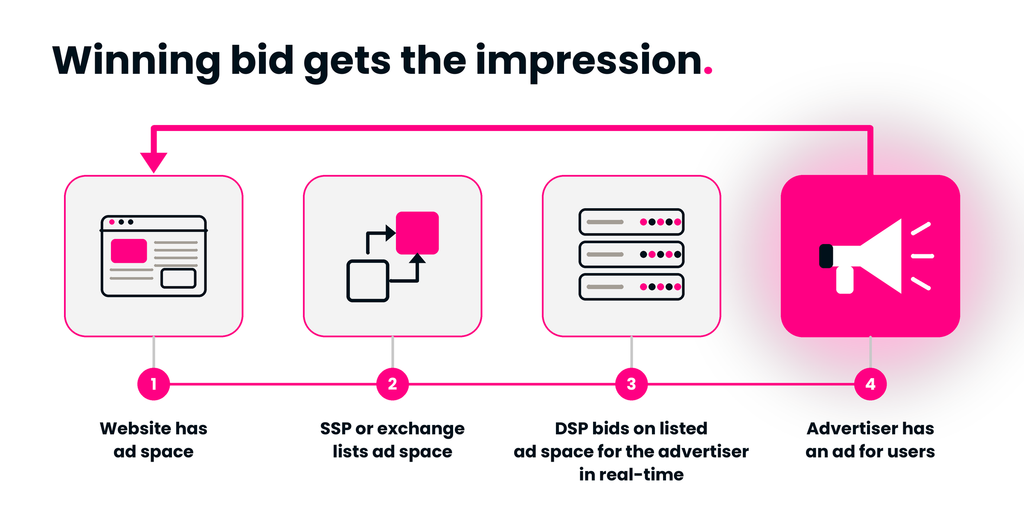
- The bid request. The moment a user clicks on a video-heavy webpage or opens a streaming app, a bid request is triggered. This request is packed with data, including the website URL, the content category, and anonymized user details like device type and approximate location. This signal is sent from the publisher’s server to the ad exchange.
- Algorithmic evaluation. Once the bid request hits the exchange, it is passed to various DSPs. This is where AI evaluation occurs. The software asks: “Does this viewer match our client’s target audience? Is the website’s content safe for this brand? What is the likelihood that this person will watch the ad to completion? “ This analysis happens instantly to determine if a bid should even be placed based on the advertiser’s parameters.
- The real-time auction. If the evaluation is positive, the software calculates the maximum value of that specific impression and submits a bid. In the modern landscape, most auctions will give the win to the highest bidder who pays the exact price they bid. This transparency helps both advertisers and publishers understand the true market value of the inventory, removing the guesswork of older models.
- Instant ad rendering. The winning ad is immediately sent to the user’s device. To ensure a smooth experience, the video is often pre-fetched or loaded in the background so that it plays without buffering. To the viewer, this looks like a seamless part of their content experience. Behind the scenes, the system records the win and begins tracking metrics like viewability and completion rate.
Key Terms in Programmatic Ads and Why They Matter
Before delving into the mechanics of programmatic video, we first need to grasp the financial and operational metrics that drive the marketplace. These terms represent the vitals of a campaign, determining whether a strategy is profitable for the advertiser and sustainable for the publisher.
- Ad inventory is the total number of ad spaces a publisher has available to sell to advertisers at any given time. This could be pre-roll slots on a YouTube channel, mid-roll breaks on a CTV app like Hulu, or outstream slots within a news article.
- CPM is the standard pricing model in programmatic advertising, representing the cost an advertiser pays per 1,000 impressions or video views.
- The fill rate is a health metric for publishers, calculated by dividing the number of ads actually delivered by the number of ad requests sent. A 100% fill rate means every single opportunity to show an ad was taken by a buyer. If a fill rate is low, it suggests that either the publisher’s asking price is too high for the market or the technical setup is failing to connect with enough DSPs.
- Ad yield is the total revenue a publisher earns from their inventory, often measured as the effective CPM. While CPM tells you the cost of a single slot, yield looks at the big picture of how much money the entire inventory is generating.
- Viewability measures the percentage of an ad that appeared on a user’s screen and for how long. High-quality execution platforms prioritize high-viewability inventory to ensure budgets aren’t wasted on ads playing “below the fold.”
- Reach refers to the total number of unique individuals who saw your video ad, while frequency is the average number of times each person saw it.
Where Do Programmatic Video Ads Run?
Programmatic video follows viewers across every screen they use, moving far beyond just website sidebars.
Streaming and CTV apps (Hulu, Peacock, etc.). Connected TV represents the gold standard of modern video advertising. These are ads watched on a television set connected to the internet, through services like Hulu, Roku, or Peacock. It is the fastest-growing area in the industry, with U.S. spending expected to reach approximately $38 billion.
Social media platforms. Mobile devices are where the majority of short-form video consumption happens. Perion’s Outmax, an AI agent, helps brands manage their presence on platforms like TikTok, making bidding decisions that are more granular than the native platform defaults. Perion clients using Outmax on TikTok have seen media performance improve by up to 25% in early results.
What is the Role of AI in Programmatic Video Ads?
AI runs programmatic video end-to-end: it evaluates every bid request, manages spend, and predicts the probability of a completed view, all within milliseconds. AI now acts as an autonomous agent that manages the complex processes of the programmatic ecosystem. It balances bid prices, evaluates the video player’s quality, and predicts the probability of a completed view.
Perion’s Outmax serves as an intelligent layer atop the traditional ad stack. Rather than just following a set of static rules, it uses predictive modeling to identify performance clusters, pockets of high-value inventory that are currently underpriced, and reallocates spend toward them instantly.
Programmatic Video Ad Formats
To maximize reach, advertisers must utilize different formats based on the environment where the viewer is engaged:
In-Stream Video Units
In-stream ads are those that play within a video player. They are usually categorized as pre-roll (before the content starts), mid-roll (a break in the middle), or post-roll (after the content). These are highly effective because the viewer has already committed to watching a video and is likely to have their sound on, leading to much higher brand recall.
Outstream and In-Article Video
Outstream ads live outside of traditional video players. You will often see them appear as you scroll through a news article; a video player will expand between paragraphs, play the ad, and then collapse once the video is finished. They are designed to be non-intrusive, as they typically only play when they are in full view of the user.
Performance-driven CTV
These ads often include interactive elements, like a QR code. This allows viewers on their couches to act on a commercial immediately, enabling advertisers to track a direct line from a TV impression to a website visit.
Online Video (OLV) Ads
Online video (OLV) is a broad category that encompasses any video advertising delivered over the internet, typically consumed on desktops, laptops, tablets, and smartphones. Unlike CTV, which is focused on the big screen, OLV is designed for the personal screen experience. These ads are highly versatile and can be used for everything from high-level brand awareness to direct-response campaigns. Because OLV spans the entire open web, it allows advertisers to follow a user’s journey across websites and apps, maintaining brand presence wherever the viewer chooses to consume their content.
Digital Out-of-Home (DOOH) Video Ads
Through programmatic DOOH, brands can buy video space on digital billboards, airport terminals, elevator screens, and even gas station pumps. The magic of programmatic DOOH lies in its ability to use real-time triggers; for instance, a beverage brand can increase its bid for video slots on street-level kiosks when local weather data shows the temperature has risen above 85F.
In-Display Ads and Sponsored Recommendations
In-display video ads, often referred to as discovery or native video ads, appear as sponsored recommendations within search results or suggested video sidebars. Instead of playing automatically before a piece of content, these ads appear as a thumbnail image with text, inviting the user to click and watch. This format is particularly effective for mid-funnel engagement because it relies on user intent. The viewer is actively choosing to engage with the video.
See what Outmax can do for your video campaigns. Connect with our team.
Advanced Targeting: How Ads Find the Right Viewers
Third-party cookies have not disappeared everywhere, but the ground has shifted enough that following users is no longer a reliable strategy. Safari and Firefox already block third-party cookies by default, and Chrome now runs on a user-choice model rather than a full phase-out. Whichever way an individual browser lands, the industry has moved from following users to understanding them, largely through:
First-Party Data Integration. It has become the operating system of the modern advertising stack. Brands now use their own customer data collected directly through website interactions, loyalty programs, and customer data platforms to power their video campaigns. Instead of guessing who might be interested, marketers upload their own encrypted customer lists to find lookalike audiences. This ensures that a brand’s video spend is focused on people who share the exact characteristics of their most profitable existing customers, turning static CRM records into scalable, high-performing video audiences.
Contextual Targeting 2.0: Contextual targeting has been reborn through AI-driven semantic and sentiment analysis. Rather than just looking for keywords, modern systems interpret the actual meaning and mood of a video’s content. For example, a running shoe brand can place its ad within a marathon highlights reel or a fitness vlog in real time. This method targets the viewer’s immediate intent, making the ad feel like a helpful suggestion rather than an intrusive tracking attempt. Research backs this up: 81% of people say they prefer ads relevant to what they are viewing, according to WARC.
AI-Driven Modeling: These models analyze millions of anonymized signals to forecast which ad placements are most likely to convert. This agentic approach to targeting allows brands to maintain high performance without needing to track individual users.
Behavioral and Retargeting in a Privacy-Frist World. Behavioral targeting has evolved into cohort-based targeting, in which users are grouped into privacy-compliant segments based on shared interests rather than on individual tracking. Similarly, retargeting is now handled through sophisticated clean rooms and universal identifiers, allowing a brand to re-engage past visitors without relying on invasive cookies.
Measuring Success: Moving Beyond the Click
Video is a top-of-funnel powerhouse, but its measurement has become much more sophisticated. Beyond mere “clicks,” professional marketers now track:
Video Completion Rate (VCR) is the primary metric for measuring creative health. It tracks the percentage of viewers who watched the ad from start to finish. In high-engagement environments like CTV, completion rates consistently reach 92%. A high VCR indicates that the targeting and the creative are perfectly aligned, proving that the audience found the message valuable enough to stay until the very end.
Viewability and human verification. High impression counts mean nothing if the ad was never actually seen. Modern programmatic measurement ensures that an ad was not only rendered but was “viewable,” meaning at least 50% of the pixels were on screen for a minimum of two seconds. AI-driven verification tools now filter out bot traffic in real-time. This ensures that every dollar of a video budget is spent on a real human being with eyes on the screen, rather than a background tab or an automated script.
To measure the “emotional” impact of a video, marketers use integrated brand lift surveys. These automated studies compare a group of people who saw the ad against a group who didn’t, measuring changes in brand awareness, ad recall, and purchase intent. This provides a clear picture of how much the video campaign moved the needle on consumers’ perceptions of the brand, which is often more valuable than an immediate sale.
Incrementality measures the “true” effectiveness of an ad by determining whether a conversion occurred because of the ad or would have happened anyway. By using controlled experiments, brands can see exactly how much “extra” revenue the video campaign generated.
The Perion Advantage – Strategy and Automation
The future of programmatic video isn’t found in a hands-off approach, but in the synergy between human strategy and machine execution. In an environment where every millisecond counts and every pixel is scrutinized, brands cannot afford to rely on fragmented tools or manual adjustments.
Perion’s advantage lies in providing a unified execution infrastructure that bridges the gap between a marketer’s vision and the technical complexities of the ad exchange.
At the heart of this ecosystem are two core technologies: Perion One serves as the central nervous system, a unified platform that breaks down the walls between CTV, DOOH, social, and the open web. This visibility enables cross-channel insights that were previously impossible to capture.
Working alongside it is Outmax, an AI agent that handles the heavy lifting of real-time optimization. Outmax actively pursues performance by identifying high-value opportunities and reallocating budgets in real time.
Real-world results show what AI execution can achieve. With Outmax optimizing delivery in real time, Webroot lowered its Cost Per Site Action by 89% and surpassed its CTV site-visit-rate benchmark by 4x. Meanwhile, C4 Energy leveraged Outmax on YouTube to exceed its view-rate benchmark by 80% and drive a 20.7% lift in brand awareness.
Ready to scale your impact across every screen? See how Outmax powers smarter programmatic video. Request a demo.
FAQS
Is programmatic video expensive?
Not necessarily. The real-time bidding model allows you to set your own price floors and ceilings.
How is brand safety handled in programmatic video ads?
Modern programmatic platforms use advanced filters and third-party verification to ensure your ads never appear next to inappropriate content. AI agents further enhance this by scanning page sentiment in real-time.
What is the main benefit of programmatic vs. direct?
Efficiency and scale. Programmatic allows you to reach a specific audience across thousands of websites and apps simultaneously, rather than signing separate deals with each publisher.


