


The Impression Multiplier in Programmatic Advertising
An impression in a single channel doesn’t always tell the full story. Users today can get exposed to an ad in multiple screens, devices and channels, extending exposure beyond a single counted view. Impression multiplier helps advertisers understand how campaigns amplify visibility across audiences, placements, and formats. Read on to learn how impression multiplier works in programmatic advertising.
What is an Impression Multiplier?
An impression multiplier is a mathematical factor used to estimate the total number of people who view a single advertisement played on a shared screen.
Unlike a smartphone or a laptop, which are one-to-one devices typically used by a single person, screens in public or shared spaces (like Digital Out-of-Home platforms or Connected TV in a living room) are one-to-many. If a digital billboard in a busy subway station flashes an ad once, it might be seen by dozens of people. The impression multiplier is the number, for example, 45, that converts a single showing into its actual volume of human impressions.
Multiple data streams are used to collect data for the impression multiplier. For example, mobile location data, such as pings from smartphones within the viewing cone of a screen. Another common way to collect data is via computer vision, such as AI-powered cameras that count faces and measure the dwell time of the user. Finally, traffic flow is commonly used to measure long-term averages of traffic in a specific area or venue.
Why Is Impression Multiplier Important for Digital Advertising?
Impression multiplier facilitates the accuracy in retail media analytics and digital advertising. Some reasons this metric is vital for a campaign’s success include:
Parity in planning allows media buyers to compare different advertising channels at the same level. If you are comparing a mobile banner to a stadium screen, the impression multiplier helps you understand the relative value of the spend.
Without a multiplier, there could be inconsistencies in attribution. For instance, a DOOH campaign can look like it is failing on paper, but the true reach is different once we apply the multiplier.
For retailers and network owners, the multiplier is how they prove the value of their physical real estate. A screen at a checkout line in a high-traffic grocery store carries a higher multiplier, thus a higher price tag, than a screen in a quiet hallway.
When is Impression Multiplier Used?
As a general rule, the multiplier is triggered whenever an ad is served on a device that is not tethered to a single user ID. This metric is used during campaign planning to forecast the potential views for a specific budget. Impression multiplier is also useful to set programmatic floor prices based on the traffic density of a specific location, so it helps during the buying process.
However, the usefulness of this metric doesn’t end with the campaign. You can use impression multipliers in your post-campaign reporting to justify the sales lift by showing that the ad reached a large audience.
How Impression Multiplier is Calculated:
Impressions multiplier correlates in the total impression formula as shown below:
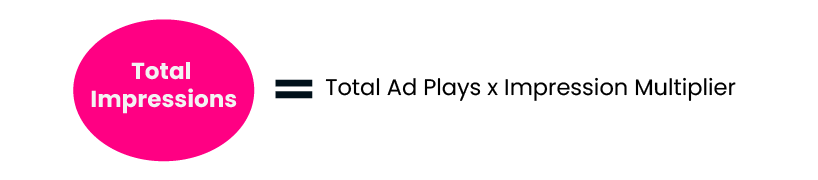
Still, to calculate the multiplier, we should do so within a specific time window, as shown in the formula below:

How Advertisers Apply Impression Multiplier in Campaign Analysis
High-impact advertisers view the impression multiplier as a dynamic lever for diagnostic analytics. Advertisers analyze which locations offer the most cost-effective exposure. For instance, if a highway billboard has a multiplier of 100 but costs 1000 and a mall kiosk has a multiplier of 10 but costs 50, the kiosk actually offers a better real CPM.
High-multiplier environments require a glanceable creative. The higher the multiplier, the simpler the ad. For example, for a multiplier of 200, the ad should be bold and simple. If the multiplier is 1.5, the creative can be more nuanced and interactive.
Platforms like Perion One leverage these multipliers to optimize high-impact units. By knowing the multiplier of a specific retail screen, the system can decide whether to serve a high-fidelity video or a static shoppable QR code to maximize resonance.
Impression Multiplier vs. Impressions
Think of the impression multiplier as the engine of the calculation and the resulting impressions as the actual mileage achieved. In a traditional digital environment, such as a mobile app, an ad impression is a simple one-to-one event where one ad request equals one view.
However, in a shared screen, the impression multiplier is an essential tool to get an accurate count when the hardware is being viewed by a group.
Impression Multiplier vs. Reach
Ad reach is the total number of unique individuals who saw an advertisement during a specific timeframe, so you can have a measure of how wide a campaign has spread. In contrast, the impression multiplier gives you a measurement of total eyes on a screen at any given moment.
Impression Multiplier vs. Frequency
While both metrics deal with the repetition and volume of an ad, they approach the concept from different angles. Frequency measures the persistence of a message, while the impression multiplier quantifies how many people are exposed to a single instance of the ad played at the same time. High frequency ensures the consumer remembers the brand, but a high impression multiplier ensures the brand has a significant share of the street.
Impression Multiplier in CTV and DOOH Campaigns
In a home environment, the impression multiplier is referred to as the co-viewing factor. As streaming services have matured, advertisers have realized that one stream rarely equals one viewer. By applying a co-viewing multiplier to the Connected TV buys, brands can accurately account for the social nature of television.
Still, the most dynamic application of this metric occurs within the Digital Out-of-Home (DOOH) sector. In modern “Smart Cities,” multipliers are updated every minute based on live data feeds.
When a train pulls into a station or a light turns red at a busy intersection, the multiplier for the surrounding screens instantly spikes. Programmatic bidding engines are built to recognize these high-impact moments, allowing brands to expand their audience exactly when the crowd is largest.
