


Full Funnel Marketing: Basics, Stages, and Its Value
Most people who visit your website are not ready to make a purchase. Moreover, customer journeys today are more fragmented, with people using multiple channels in their purchase process. Having a full-funnel strategy that takes these factors into account is critical for success. Let’s explore what it is and how to build the perfect full funnel marketing strategy.
What is Full Funnel Marketing?
The term full funnel marketing refers to a strategy that takes a customer through all stages of the marketing funnel. The marketing funnel is a diagram that outlines a straightforward path a customer may take in the purchasing journey. A full funnel marketing strategy starts at the top of the funnel and goes all the way until conversion.
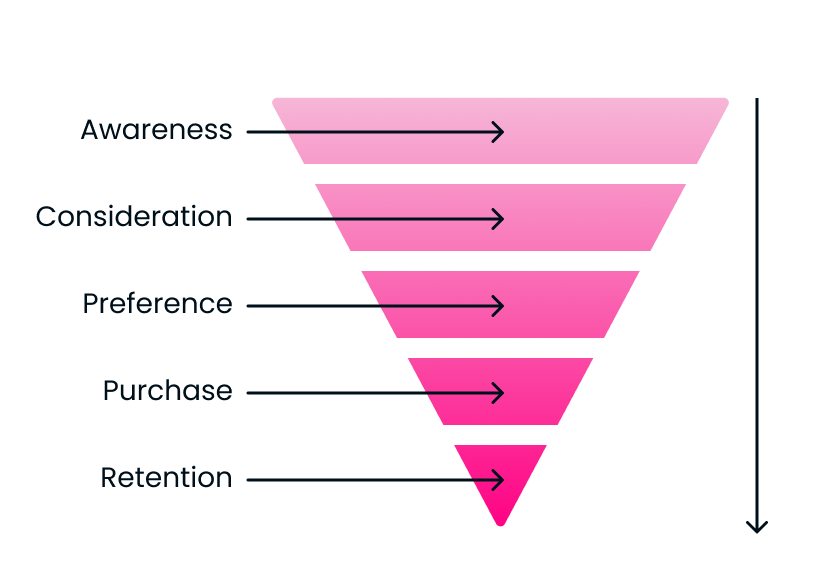
Let’s explore the different stages of the marketing funnel:
Top of the Funnel
Corresponds to the awareness stage. The early steps of the purchasing journey, when the brand addresses a large audience of people who may or may not have heard about it. Popular top-of-the-funnel strategies include content marketing (blog posts, articles, infographics) with SEO and SEM strategies, social media campaigns, including reels.
Other examples of top-of-the-funnel strategies include DOOH campaigns such as Perion’s campaign for Bakers Delight. Display ads and interactive content can also be used as top-of-the-funnel strategies.
Middle of the Funnel
Corresponds to the consideration stage. Strategies at this stage focus on nurturing leads and building trust. Examples include personalized email marketing campaigns and retargeting ads. Content marketing strategies that cater to the middle of the funnel include more in-depth content, such as eBooks, whitepapers, and case studies.
Bottom of the Funnel
Corresponds to the conversion stage. At this point, strategies give the last nudge to convert prospects into customers. Examples of strategies at this point include product demos, limited-time promotions, CTAs, and abandoned cart recovery campaigns.
Why is the Full Funnel Marketing Strategy Important?
Customer journeys are not linear, and a full-funnel strategy helps you reach more customers by getting to them at different stages. Real customer behavior is often multi-channel, with buyers skipping steps or re-entering at different points. By activating awareness, consideration, and purchase, brands ensure they’re present wherever customers are in their journey.
A full funnel strategy also allows for a broader reach and efficiency. If your strategy targets conversions, you can miss early-stage prospects. The opposite is also true. If you only aim for awareness, closing sales will be more difficult. Integrating all stages creates a single, coordinated growth engine, with cohesive momentum. Early-stage investments fuel mid-and low-funnel performance, boosting organic visibility, reducing acquisition costs, and improving overall ROI.
How to Build a Full Funnel Marketing Strategy?
To build a full-funnel marketing strategy, you should align the tactics with each stage of the customer journey. Here are the basic steps:
- Define your goals. Identify clear objectives for each stage: awareness, consideration, conversions.
- Define your audience: choose who your buyer persona is, and segment your audience.
- Map the customer journey: outline how prospects move from discovering your brand to making a purchase.
- Choose tactics for each funnel stage: for instance, content marketing, DOOH, for the top of the funnel. For the middle of the funnel strategy, you can implement whitepapers, email nurturing, and retargeting campaigns.
- Leverage data and technology: use advertising solutions to provide automation, DSPs, and analytics to deliver personalized campaigns.
When is Full Funnel Marketing Used?
Brands use full-funnel marketing when they want to create a comprehensive strategy that nurtures customers through their entire journey, not just at the point of purchase. Instead of focusing solely on driving conversions, this approach ensures marketing efforts that build awareness, consideration, and encourage action.
Businesses that have longer or more complex buying cycles, such as automotive, technology, or healthcare, are also prime candidates for a full funnel marketing strategy. These customers need more time and information before making a purchase. For instance, B2B software or real estate.
This strategy is also used in competitive markets because a business can reach potential customers across different funnel stages, which may help it stand out.
How to Measure the Full-Funnel Strategy Success?
One strategy to measure full funnel marketing campaigns’ success is to set clear goals and defined KPIs for each stage. Track metrics like engagement rates, customer acquisition cost (CAC), and customer lifetime value (CLTV). These metrics can help you see how customers move through the journey. Afterwards, you can calculate the ROI and return on ad spend (ROAS).
