


Multi-Touch Attribution: Know Where the Conversions Come From
Digital customer journeys may include multiple interactions before purchasing. Therefore, if you are only crediting the final interaction before a sale, you are missing the hidden influences that truly drive conversions. Multi-touch attribution solves this by mapping eerie interaction, from the first point of interest to the final decision. Read on to discover how multi-touch attribution works and how to use it.
What is Multi-Touch Attribution?
Multi-touch Attribution (MTA) is a measurement framework that tracks every digital interaction a customer has before they convert. Rather than giving all the credit to the final click, MTA acknowledges that a sale results from a series of events. Some differentials of multi-touch attribution include:
- The fractional value of interaction. Unlike winner-take-all credit systems, MTA assigns a fractional value to each touchpoint. That means if a customer interacted with four different ads before purchasing, the value of that sale is distributed among those four ads based on their impact. This prevents last-click bias, where the bottom-funnel ad gets 100% of the credit while the awareness-building ads are perceived as failures.
- Visualizing the customer path. One of the most powerful differentials of MTA is that it visualizes the actual steps a lead takes toward a purchase. By stitching together timestamps and user IDs, marketers can see the common paths that high-value customers take. The visibility allows brands to identify sequences of interactions that consistently lead to higher conversions.
Full funnel visibility.MTA gives full funnel visibility, including awareness-building touchpoints that often go unmeasured. In a full-funnel advertising strategy, top-of-funnel activities like programmatic DOOH are essential for filling the pipeline. MTA ensures these crucial early interactions are credited for their role in moving the customer along the funnel.
What are Multi-Touch Attribution Components?
MTA gathers data from disparate sources into a single view. For instance, tracking scripts to identify users and an attribution engine to process the logic. Identity resolution is critical to ensure a mobile click and a desktop purchase are linked to the same person.
The key steps of MTA are:
- User identifiers include tracking tags, pixels, and cookies that follow the user journey. These snippets of code record every ad impression and click, attaching a unique ID to the user’s browser or device. This “digital paper trail” allows the system to reconstruct the journey after a conversion.
- Data integration connects ad platforms with CRM data and point-of-sale systems. By syncing these disparate data sets, marketers can see not only that a user clicked an ad, but also how much they spent and whether they became a repeat customer.
- The final component is the attribution model itself, which can range from simple linear models to advanced audience-targeting algorithms such as Perion Outmax.
Linear vs. W-Shaped Attribution
Understanding the specific math behind different models is key to implementing MTA efficiently. Two of the most common models used are the linear and W-shaped models.
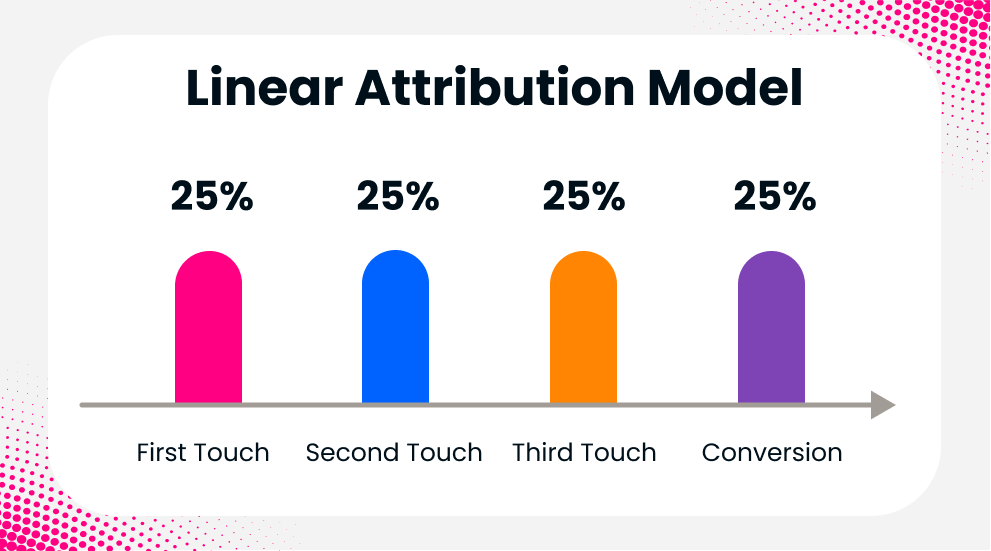
Linear attribution is a multi-touch marketing that gives equal credit to every touchpoint on the customer journey. If a customer interacts with five ads before purchasing, each ad receives 20% of the credit. This model is best for brands with shorter sales cycles, where every interaction is deemed equally important in maintaining momentum.
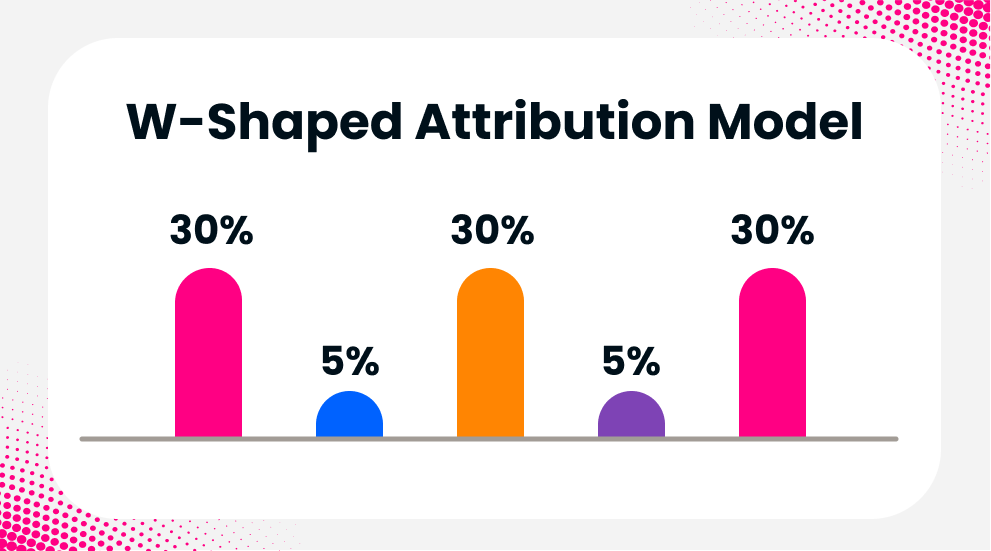
W-shaped attribution is a multi-touch marketing model that assigns 30% credit each to three key touchpoints, totaling 90%, with the remaining 10% distributed among intermediate interactions. These three touchpoints are usually the first touch, the lead creation, and the opportunity creation. This model is great for complex B2B or high-ticket B2C journeys.
Why is Multi-Touch Attribution Important?
Relying on last click attribution leads to poor spending decisions because it ignores the channels that actually introduced the customer to your brand. MTA provides the evidence needed to scale top-of-funnel campaigns that are working but might not directly close the sale.
It identifies underperforming channels that do not assist in conversions. This allows for the reallocation of the budget to high-impact creatives that move the needle. Because MTA shows which messaging works best at specific stages, applying this framework simplifies calculating the return on investment for every marketing dollar spent.
How does Multi-Touch Attribution Work?
MTA assigns a percentage of a conversion’s value to different interactions. When a sale is logged, the system reviews the user’s history and distributes the value across touchpoints based on a chosen mathematical model. This allows you to see, for example, that a blog post contributed 15% to a purchase.
The key steps are as follows:
-
- Data collection: Storing every impression and click with a timestamp and user ID across all devices.
- Calculating credit: Reconstructing the sequence of events into a single, cohesive path-to-purchase for each customer.
- Strategic comparison: Comparing different models to find the one that most accurately represents your sales cycle.
When is Multi-Touch Attribution Used?
MTA is best suited for complex sales environments and long customer journeys. If your customers typically interact with your brand several times over several days or weeks before converting, MTA is the right model. MTA is the standard for high-consideration industries where the journey involves significant research and multiple touchpoints.
Multi-touch attribution is best suited for complex digital ecosystems, such as brands operating across multiple platforms. In industries like automotive, real estate, or enterprise software, the cost of acquisition is high, and the sales cycle is long. MTA provides the granular data needed to protect these investments, ensuring that every touchpoint is optimized for maximum impact.
The Difference Between Multi-touch Attribution and Single-touch Attribution
The main difference lies in perspective. Single-touch attribution provides a narrow, binary view of success. It assumes that only one moment matters, which is rarely true in a modern browsing environment. Multi-touch attribution provides a panoramic view, acknowledging that the consumer’s decision is an accumulation of trust and information gathered over time.
| Feature | Single-Touch Attribution | Multi-Touch Attribution (MTA) |
| Data Credit | 100% credit goes to one touchpoint (First or Last). | Fractional credit is distributed across all touchpoints. |
| Complexity | Low; easy to set up in standard tools like Google Analytics. | High: requires advanced identity resolution and data integration. |
| Customer Journey | Assumes a linear, one-step path to purchase. | Maps non-linear, cross-device, and long-term journeys. |
| Strategic Focus | Short-term: prioritizes immediate conversion. | Long-term: prioritizes brand building and awareness. |
| Budget Allocation | Often leads to over-investing in Search and under-investing in Video/TV. | Justifies spending on top-of-funnel channels like Connected TV (CTV). |
| Accuracy | Prone to “Last-Click Bias,” ignoring early brand discovery. | High: reveals the “Halo Effect” of mid-funnel and awareness ads. |
| Best For | Short sales cycles and simple, direct-response products. | Complex ecosystems, high-value goods, and long sales cycles. |
Benefits of Using Multi-Touch Attribution
Multi-touch attribution’s main benefit is that it delivers a clear roadmap for your campaign. By knowing which sequence of touchpoints is most likely to result in a sale, you can replicate that success across your entire customer base.
Thus, MTA gives you the confidence to scale. When you can prove that your top-of-funnel ads are assisting 40% of your total revenue, you can aggressively increase spend in those areas without fear. This data-backed approach gives a competitive advantage to companies.
Finally, MTA eliminates non-productive touchpoints, so you can eliminate the fluff from your journey and shorten your sales cycles.
