


Mobile Over the Top (OTT) Explained Beyond the Screen
As streaming habits shift towards portability, Mobile Over-the-top (OTT) has emerged as an opportunity for advertisers. It delivers high-quality video content directly via internet-connected apps (think Netflix or Prime apps on your phone) rather than broadcast or cable, brands can now reach highly engaged audiences exactly where they spend their time, on their smartphones and tablets. Read on to learn how mobile over the top works and how to use it on your campaigns.
What is Mobile Over the Top in Advertising?
Mobile OTT refers to the delivery of film and TV content via the internet to mobile devices, bypassing traditional distribution platforms like satellite or telecommunications providers. In the advertising world, this represents a sophisticated hybrid of the lean-back TV experience and the lean-forward precision of digital targeting. Thus, brands can use mobile over the top to present large-scale, cinematic narratives while leveraging the exact data signals that make digital marketing highly efficient.
Some characteristics of mobile OTT are:
- It uses app-based delivery. Content is accessed through dedicated apps like Hulu, Netflix, or Disney+ on mobile OS. Rather than accessing content through an internet browser or a hardware set-top box provided by a telecommunications company, users interact with dedicated applications built natively for iOS or Android.
- This direct app-to-user ecosystem enables publishers to implement robust AVOD (Advertising Video On Demand) to insert commercials into premium streams. Users can then consume content for free or at a reduced subscription price in exchange for viewing ads.
- By operating over the internet, the structure bypasses traditional distribution gatekeepers. Advertisers no longer need to negotiate complex regional linear TV contracts or work within the rigid constraints of traditional cable. Therefore, advertisers connect directly with users without needing a cable provider intermediary.
Primary Types of Mobile OTT Advertising
Mobile OTT engages consumers through distinct visual and interactive mechanisms. Common types of mobile OTT include in-stream video ( pre/mid/post-roll), interactive/shoppable ads, and display banners within streaming apps.
In-stream video ads are the standard format of mobile OTT media, mirroring the familiar structure of linear television commercials but enhanced with digital precision. These ads are embedded directly into the streaming video player and run sequentially alongside the primary film or show. They are categorized based on the structural placement within the viewer’s session.
- Pre-roll ads are positioned at the beginning of a video stream, capturing the consumer’s peak attention before their chosen content starts.
- Mid-roll ads are scheduled at natural narrative breaks or designated commercial intervals during a broadcast, ensuring high completion rates as viewers are already deeply invested in the program.
- Post-roll ads are appended to the end of a video asset, which is highly effective for delivering direct response calls to action immediately after a user has finished a viewing session.
Interactive and shoppable ads deliver top-of-funnel brand storytelling and immediate digital conversion. Unlike traditional television screens, smartphones and tablets provide an intuitive touch interface that allows viewers to engage directly with the commercial creative.
App-based display banners provide a non-intrusive mechanism to maintain continuous brand visibility without disrupting the core viewing experience. These ads do not live inside the video player itself. Instead, they are served within the graphical interface of AVOD and FAST services. App-based banners are scalable and serve as an exceptional tool for retargeting.
Types of OTT Distribution Channels
Once advertisers choose the best type of ad for the campaign, it’s time to select the right distribution channel for the ads. Below are the main options:
| OTT Distribution Channel | Pricing Model | User Experience | Main Advantage |
| AVOD (Advertising Video on Demand) | Free or low-cost tier supported by ads. | Unskippable pre-roll or mid-roll commercials. | Maximum reach and scale across diverse demographics. |
| SVOD Hybrids (Subscription + Ads) | Reduced the monthly fee with limited ad load. | High-quality, premium mid-roll placements. | Extremely low churn rates and highly premium content environments. |
| vMVPDs (Virtual Multichannel Video Programming Distributors) | Premium subscription for live TV over the internet. | Traditional commercial breaks during live broadcasts. | Captures live sports and breaking news audiences in real time. |
Why is Mobile Over the Top Important?
Mobile OTT is vital because it captures attention in a fragmented media landscape, offering the sight, sound, and motion of television with the data-driven intelligence of mobile tracking.
- Portability: Mobile devices accompany users everywhere, meaning brand exposure is no longer restricted to the living room. Enables brand exposure during commutes, breaks, and travel.
- Precision targeting: Because these apps require user logins and run on devices with unique identifiers, advertisers can leverage first-party data, device IDs, and location signals for surgical accuracy.
- High completion rates: Mobile OTT viewers are often locked in to their content, leading to higher ad recall.
How does Mobile Over the Top Work?
The technical execution of a mobile OTT ad happens in a matter of milliseconds. When a user hits play on a mobile app, an ad request is sent via an API or SDK, which then fills the slot with a relevant, high-definition video creative.
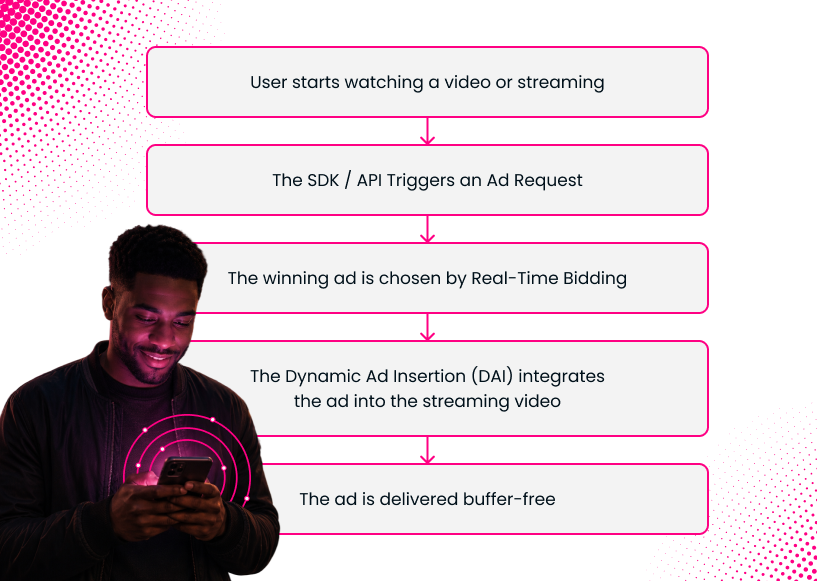
When a user opens a streaming application, the app’s underlying code triggers an ad request. This request initiates a real-time bidding auction. Within milliseconds, programmatic platforms evaluate the user profile, determine the value of the impression, and place bids on behalf of competing advertisers. The winning creative is selected instantly, and dynamic ad insertion is used to embed the ad directly into the main video stream.
Some aspects of the process include:
- Dynamic ad insertion (DAI): Ads are inserted into the video stream for a buffer-free experience.
- Real-time bidding (RTB): Ad placements are often bought and sold in milliseconds via programmatic auctions.
- Cross-device tracking: Links mobile viewing habits to other household devices for a unified user profile.
Essential OTT Metrics
To evaluate the financial efficiency and performance of a mobile OTT deployment, you must monitor specific digital performance metrics.
| Metric | Definition | Core Purpose & Context |
| Video Completion Rate (VCR) | The percentage of times an advertisement played completely to the end. | Measures baseline viewing engagement; mobile OTT consistently maintains a VCR above 90% due to unskippable premium streaming environments. |
| Cost Per Completed View (CPCV) | Calculated by dividing the total advertising spend by the number of times the video played to 100% completion. | Financial optimization metric ensuring brands pay for verified, full engagement rather than abandoned or partial impressions. |
| Gross Rating Points (GRP) | A traditional broadcasting metric adapted for digital media that measures advertising impact by multiplying total reach by the average frequency of exposure. | Bridges the gap between traditional TV buying and digital streaming to measure overall campaign scale and penetration. |
| Click-Through Rate (CTR) | The ratio of users who tap on an interactive overlay or call-to-action button compared to the total number of ad impressions delivered. | Evaluates lower-funnel performance and the effectiveness of interactive, shoppable, or direct-response elements. |
| Ad Impression Validity / Invalid Traffic (IVT) | The percentage of ad impressions verified as genuine human views. | Filters out automated bot activity or background app refreshes to guarantee ad fraud mitigation within streaming apps. |
When is Mobile Over the Top Used?
Mobile OTT is most effective when a campaign requires high-brand lift or needs to reach cord-cutters who don’t own a television. It is the go-to choice for product launches, seasonal promotions, and storytelling-heavy campaigns that require solid engagement.
When a brand needs to convey emotional depth, demonstrate complex product features, or build a distinct identity, static banners or short text ads fall short.
Benefits of Using Mobile Over-the-Top in Advertising Campaigns
Some of the benefits of including mobile over the top include eliminating fraud risk and enhanced interactivity. Ads run within a walled garden app, which reduces the risk of bot traffic. Moreover, mobile devices allow for click-through capabilities that traditional TVs lack. It also allows advertisers to deliver different creative versions to different users based on their specific interests or behaviors.
