


Last Touch Attribution – Tracking the Path to Conversion
Digital advertising demands a clear understanding of which touchpoints drive immediate action. Last touch attribution simplifies this by crediting the very last interaction a user has before converting. While complex multi-touch models exist, focusing on the final click provides a high-intent snapshot of what closes the deal. Read on to understand how to leverage this model to optimize bottom-of-funnel performance and sharpen your short-term advertising ROI.
What is Last Touch Attribution in Advertising?
Last touch attribution is a single-touch measurement model that ignores every previous interaction in the customer journey, focusing exclusively on the final touchpoint. Whether a user saw ten ads previously or none, the channel that delivered the final click receives the full credit for the conversion.
This model operates on the principle of single-source credit, providing a simplified path that is entirely conversion-centric. Because it is easy to implement and interpret, it remains the default standard for many analytics platforms.
Why is Last Touch Attribution Important?
Understanding what triggers the final buy decision is critical. It allows advertisers to see which channels are most effective.
- Performance benchmarking. Last touch attribution provides a concrete foundation for performance benchmarking across various marketing channels. By attributing success to the final interaction, marketers can establish a clear baseline for what a successful conversion looks like. This data allows teams to compare the closing power of different platforms on an equal playing field. Without the benchmark, it becomes difficult to determine which specific tactics are actually responsible for moving the needle on revenue and which are peripheral.
- Budget efficiency. Focusing on the final touchpoint identifies which channels consistently drive the final click. This allows advertisers to reallocate funds away from underperforming closers and towards those that have a proven track record of conversion. This prevents wasteful spending on bottom-of-funnel tactics that fall to convert, and optimizes the budget efficiently.
- Simple implementation. Last touch can be implemented using basic, free tools like Google Analytics. This accessibility allows businesses to begin measuring their marketing impact immediately without a massive upfront investment in technical infrastructure, making it an ideal starting point for organizations just beginning to track their digital performance.
- Immediate insights. This simplicity of implementation allows for quick insights that help make campaign adjustments in real time. Because the data is based on a single, verifiable click, there is no ambiguity or delay in the reporting.
How does Last Touch Attribution Work?
Last touch attribution is a linear process, drawing a direct line between a single action and the resulting revenue, eliminating the noise of the rest of the journey.
How to Calculate Last Touch Attribution
To calculate last touch attribution, you need to identify the last action before conversion and then assign the conversion to it. For example, a user’s journey has the following steps:
- Visiting a website
- Signing up for a newsletter
- Receives email
- Gets a retargeted ad
- Makes the purchase
In this case, the model attributes 100% of the conversion to step 4: getting a retargeted ad, as it is the last point before the conversion.
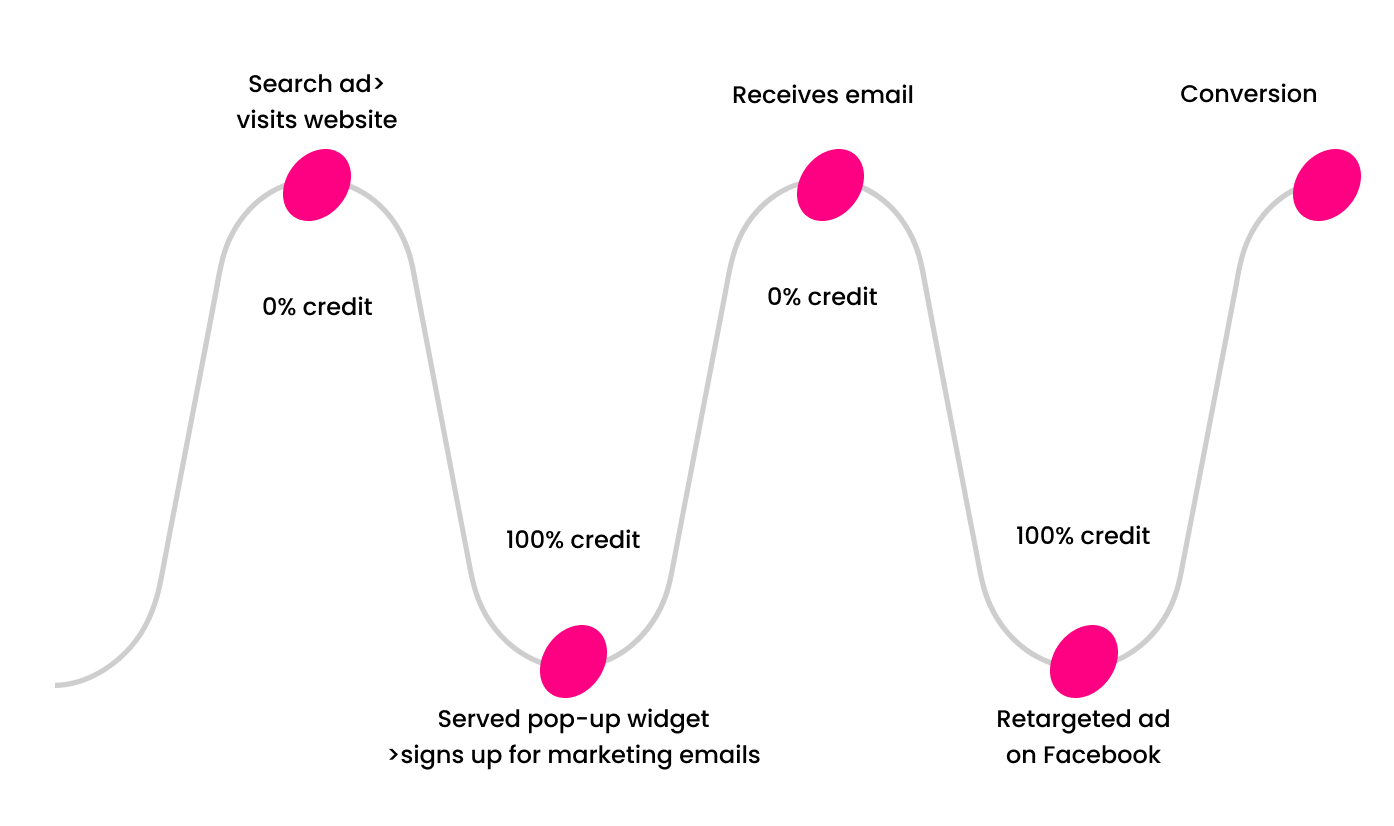
Here are the key steps to calculate last touch attribution
- Identify the conversion event. The process begins by clearly defining what constitutes a win for the business, known as the conversion event. This might be a completed checkout on an e-commerce site, a lead form submission for a B2B service, or even a download button. Without a strictly defined conversion event, the attribution model has no target to track toward.
- Locate the most recent click of interaction. Once a conversion event is triggered, the analytics system looks backward through the user’s journey to find the most recent interaction. This is typically done through browser cookies or tracking pixels that record the user’s path. The system ignores every previous touchpoint and focuses solely on the very last link the user clicked before arriving at the conversion page.
- Assign the total revenue or goal completion. In the final step of the calculation, 100% of the credit for the conversion is assigned to that last identified source. If the user clicked a branded search ad and then spent $180, that specific search campaign is credited with the full $180 in revenue.
When is Last Touch Attribution Used?
Last touch attribution model isn’t a one-size-fits-all solution, but it excels in specific scenarios where the path to purchase is direct. It is most effective when the primary goal is to measure the immediate impact of a specific call to action. Below are some uses of the last-touch attribution model.
Direct Response Campaign
These campaigns are built to drive an immediate, measurable action, making them the perfect candidate for last touch attribution. Whether it is an “install now” button for a mobile app or an ad to claim your discount, the intent is for the user to convert in a single session. In these cases, the historical journey is less relevant, and these high-pressure, high-intent tactics are more important.
Short Sales Cycles
In industries where the sales cycle is short, for example, with impulsive or transactional purchases, the last touch is the most accurate model. For example, in food-delivery services and fast food. When the time between discovery and purchase is minimal, the last touchpoint is almost always the only touchpoint that truly matters for the brand.
Promotional Sprints
During high-intensity sprints, such as a 24-hour flash sale or a Black Friday event, last touch attribution provides the necessary speed and clarity. These events are designed to create urgency, pushing users to the final click through aggressive offers and limited-time deals. Marketers use last touch in these scenarios to see which specific promotional channel.
Initial Testing
For brands launching a new product or entering a new market, last touch attribution serves as an excellent tool for initial testing. For instance, by offering a clean look at which channels can stand on their own and drive sales, it helps marketers identify low-hanging fruit.
Benefits of Using Last Touch Attribution
The popularity of last touch attribution persists because it prioritizes action and clarity over theoretical complexity.
The most immediate benefit is the absolute clarity it provides to stakeholders and executives. There is no need to explain complex weights or decay percentages; the data simply shows that “channel x led to sale y”. The simplicity of this model is a significant asset. It requires minimal configuration and avoids the analysis paralysis that comes with multi-touch attribution. It is the leanest way to manage a performance-driven marketing budget.
While it is often criticized for ignoring assist channels, the last touch is accurate at identifying closers. In any marketing ecosystem, you need channels that are designed to finalize the deal. Multi-touch attribution models often struggle with data noise, where irrelevant interactions are given undue credit simply because they occurred in the user’s history. Last touch attribution reduces this noise by stripping away everything except the final, most relevant click.
Last Touch Attribution vs. First Touch Attribution vs. Linear Attribution.
Choosing the right attribution model depends on your marketing goals and the complexity of your customer journey. While last-touch attribution is the industry standard for simplicity, other models, such as first-touch attribution and linear attribution, are useful at different stages of the customer journey.
| Model | How It Works | When to Use |
| Last Touch | Assigns 100% of the credit to the final interaction or click before a conversion occurs. | Use for short sales cycles or when your primary goal is to identify what directly drives immediate conversions. |
| First Touch | Assigns 100% of the credit to the very first interaction a customer had with your brand | Ideal for brand awareness campaigns where you want to see which channels are filling the top of your funnel |
| Linear | Distributes credit equally across every touchpoint the customer interacts with throughout their journey | Best for long, complex sales cycles where every interaction plays a significant role in nurturing the lead |
| Multi-touch (MTA) | Uses weighted logic to distribute credit across multiple touchpoints. | High-ticket items or B2B sales, where customers interact with your brand many times across different platforms before buying. |
