

Interstitial Ads: How to Capture Attention Between Content
Grabbing the user’s attention is the first step to lead them on the customer journey. However, the crowded digital advertising market makes it increasingly difficult to do so. Ads appear everywhere on pages, videos, and apps. Interstitial ads help brands break through by delivering full-screen, immersive messages at strategic moments.
Keep reading to discover the types, benefits, best practices, and performance strategies for integrating interstitial ads into your campaigns.
What Are Interstitial Ads?
Interstitial ads are full-screen interactive overlays that cover the interface of a host application or website. Unlike banner ads, which occupy a small portion of the screen, interstitials command the user’s entire field of vision. They are designed to appear at natural transition points, also known as logical breaks, within the user experience, such as between game levels, while a page is loading, or before a video begins.
How Interstitial Ads Work?
Interstitials function on a trigger-based system. When a user reaches a specific “breakpoint” in their navigation, the ad call is initiated.
- The trigger phase. The process begins when a user completes a specific task, such as clicking a “Next” button on a multi-page article or finishing a round in a mobile game. This action signals to the app or site that a transition is occurring.
- Background loading. To prevent latency and ensure a seamless experience, many developers pre-fetch the ad in the background. The ad is fetched from the server and cached so it is ready to display the moment the trigger is activated.
- Full-screen display. Once the transition point is reached, the ad expands to occupy the full screen. Therefore, the user gets undivided attention by temporarily removing all other content and navigation elements.
- User action and exit. The final stage involves user interaction. The viewer can either engage with the Call to Action (CTA) or wait for a “Close” or “X” button to appear. The exit button returns the user immediately to their original content flow.
How Interstitial Ads Fit into Programmatic Advertising?
In the programmatic ecosystem, interstitial inventory is bought and sold through Real-Time Bidding (RTB). Publishers define their interstitial slots within their Supply-Side Platform (SSP). These slots are marked as high-impact areas where the app or site can support a full-screen overlay without breaking the user experience.
When a user hits a transition point, the SSP sends a bid request to Demand-Side Platforms (DSPs). Advertisers use data-driven audience segmentation and targeting, focusing on demographics, interests, and behavior, to bid on that specific impression in milliseconds.
Because interstitials offer near 100% viewability, they often command a higher floor price in programmatic auctions compared to standard display units. They are treated as premium inventory due to their ability to capture total user focus.
How to Measure Interstitial Ads Performance?
An ad campaign’s success is measured through a combination of traditional and format-specific Key Performance Indicators (KPIs).
- Click-Through Rate (CTR) represents the percentage of users who clicked the ad compared to the total number of impressions. It is a primary indicator of how compelling the creative and CTA are to the target audience.
- The conversion rate measures the percentage of users who completed a desired action, such as a purchase or a sign-up, after clicking the ad. This determines the actual ROI of the interstitial campaign.
- Impression depth tracks how long a user stayed on the ad before choosing to close it. High impression depth suggests that the content was relevant enough to hold the user’s interest even if they didn’t click.
- Exit rate. This identifies the percentage of users who closed the app or page entirely rather than simply closing the ad. A high exit rate often indicates that the ad was poorly timed or perceived as too intrusive.
Types of Interstitial Ads
Advertisers choose formats based on their campaign goals and the technical capabilities of the platform. For instance, ads can be static, video, or rich media.
Static interstitials are the most fundamental form, consisting of a high-quality image and a clear CTA. These are best suited for brand awareness and simple promotions due to their fast loading times and low production costs.
Video interstitials play a short video clip, usually lasting between 15 and 30 seconds, before the user can proceed. They are the primary choice for storytelling and product demonstrations, offering higher engagement rates and better emotional resonance than static images.
Rich media units include interactive elements like mini-games (playable ads), carousels, or lead-generation forms. They are designed for deep engagement, providing value or entertainment that makes the advertisement feel like a feature rather than an intrusion.
Interstitial Ads in Mobile vs Desktop
While the core concept remains the same, the execution varies significantly between devices due to screen real estate and user behavior.
Interstitials are exceptionally effective within mobile apps. They capitalize on the limited screen size to eliminate all peripheral distractions. This format is a staple in mobile gaming and utility apps where natural pauses occur frequently.
On desktop, these ads often appear as splash pages or overlays. Because desktop users have more screen space and frequently switch between browser tabs, these ads must feature high-impact visuals to prevent the user from simply navigating away from the window.
Best Practices for Interstitial Ad Placement
The line between high-impact and annoyance is thin. To maintain a positive User Experience (UX) and avoid SEO penalties, advertisers must follow strict guidelines.
Respect the content flow. Ads should only be placed at natural breaks. It is critical not to interrupt an active task, such as in the middle of a game or while a user is actively typing into a form, as this leads to frustration.
Implement frequency capping. Frequency capping limits how many times a single user sees an interstitial within a specific session. Overexposure leads to ad fatigue and high user churn, diminishing the long-term value of the campaign.
Provide clear exit options. The “close” button must be clearly visible and immediately functional. Hiding the exit button violates major platform policies and creates a negative brand association for the user.
Optimize the loading speed. Large file sizes can cause delays that disrupt the user flow. Optimizing assets for fast loading ensures that the ad appears instantly, reducing the likelihood of the user abandoning the page before the end of rendering.
Maintain search engine compliance. Ensure all ads comply with the IAB Ads Standard. Google and other search engines may penalize sites that use intrusive interstitials.
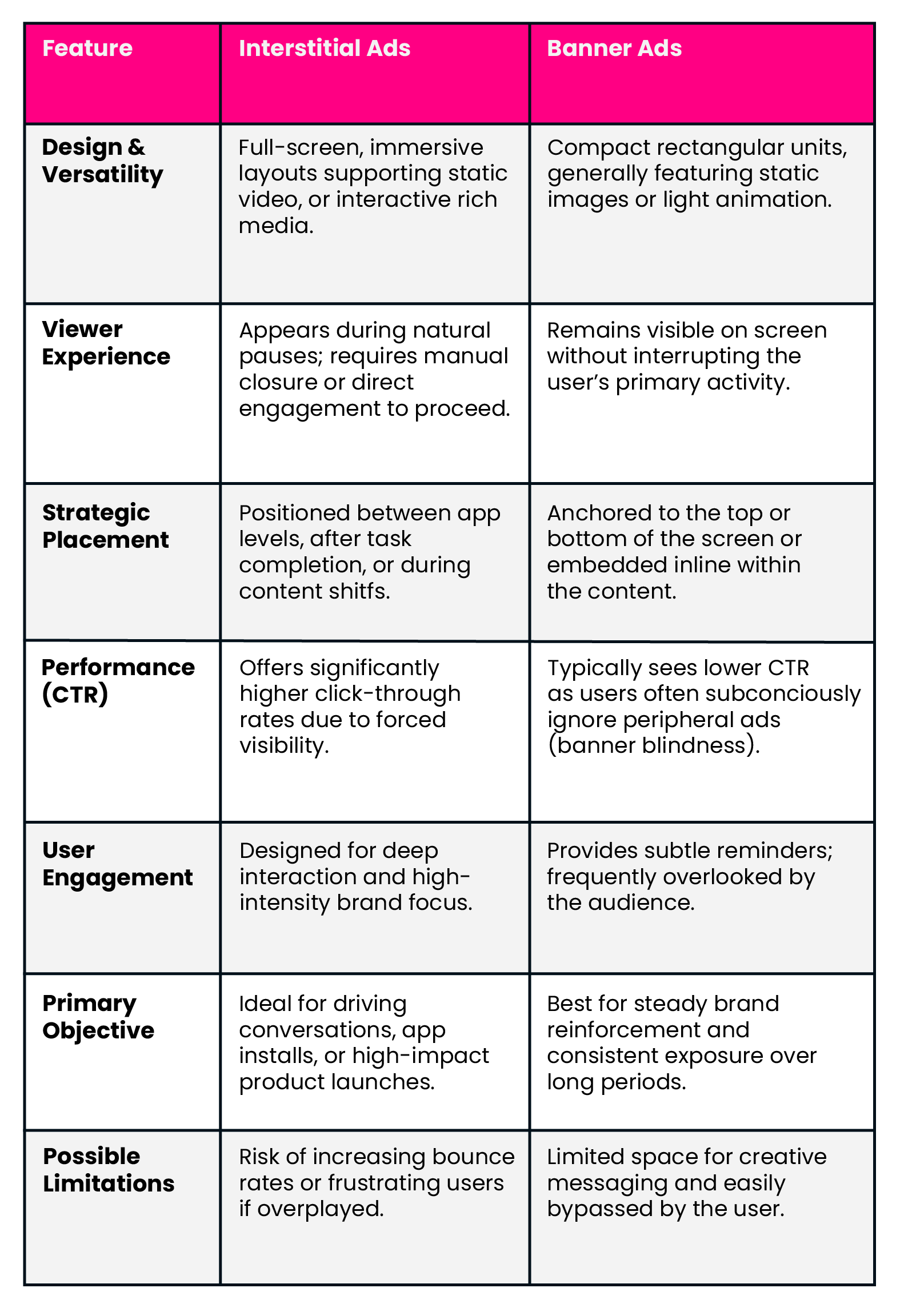
Interstitial Ads vs Banner Ads
Banner ads are a staple of digital advertising, and they are not going anywhere. Contrary to interstitial ads, banner ads stay static on a placement. They come in several sizes and placements, such as above the fold or below. Interstitial ads are full-screen, appear in between pauses in the user experience, and require an action to close them. Here are the key differences between them: