


Effective Cost Per Mille (eCPM): How to Increase Ad Revenue
One of the pricing models in digital advertising is the CPM (Cost per Mille), where advertisers pay publishers per thousand impressions. With CPM, advertisers know what they will pay for each impression. eCPM, on the other hand, measures what publishers earn from these impressions. Read this glossary page to understand how to calculate eCPM and optimize it for revenue.
What is Effective Cost per Mille (eCPM)?
Effective Cost per Mille (eCPM) is a metric that measures the revenue the publisher gets for every 1000 impressions. This metric works regardless of the ad pricing model used, despite its name. You can calculate eCPM with CPM, CPC, and CPA pricing models. When you calculate eCPM, it combines the average of all advertisers’ bids for your ad impressions. Thus, this metric helps you to learn how much you can earn for different bidding models. With eCPM, publishers can evaluate how their ad inventory is performing.
Why is eCPM Important?
eCPM is important for publishers as a tool to evaluate their potential revenue from their ad revenue, helping them understand how profitable their ad inventory is. Publishers can compare different ad placements and formats, refine their strategy, and even estimate future profitability.
One of the reasons eCPM is important for publishers is that it gives publishers a way to understand how much they are really earning from their ad placements, independently of the pricing model. When analyzing eCPM, publishers can identify which ad formats, sizes, and placements perform the best.
By comparing the effectiveness of the different ad placements, publishers can adjust their monetization strategies and increase revenue. eCPM also works as a basis to estimate future earnings.
How Do You Calculate eCPM?
The formula to calculate eCPM takes the total revenue and divides it by the total number of ad impressions, then multiplies it by 1000. The formula is as follows:
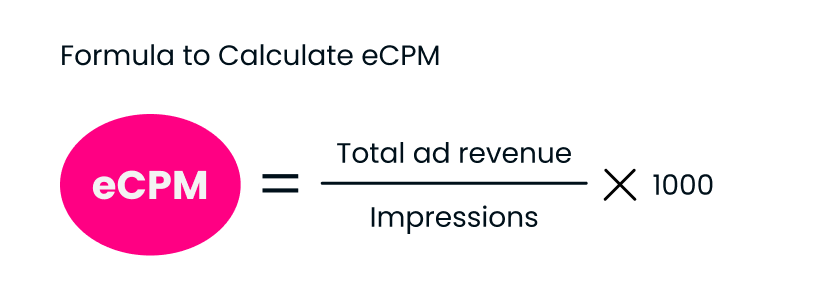
Here are the components of the formula:
- Total ad revenue is the total amount of money the publisher earned from the ad slots during a specific period.
-
- Total ad impressions are the total number of times the ads are displayed on a user’s screen over the same period.
- Divide revenue by impressions to get the ratio, then multiply it by 1,000 to get the per mille basis.
For example:
If you earned $100 from ads and those ads were shown 20,000 times:
$100 / 20,000 = 0.005 * 1000 = $5
What’s a Good eCPM?
A good eCPM will vary according to the industry, as what is considered high in one industry can be low in the other. Factors such as ad format, ad quality, and the target audience heavily influence the rates.
For instance, the display ads eCPM usually goes lower than video ads, with a range from $1-$3 instead of $5-$10. High-demand niches such as finance, tech, or healthcare rates go higher, exceeding $20. When the eCPM is too low, publishers risk losing money. To prevent that, they set what is called an eCPM floor.
What’s an eCPM Floor?
The eCPM “floor” is the minimum price a publisher sets for 1,000 impressions of an ad. Typically, this price is set in a programmatic auction. The impression is not sold at a price lower than the floor, helping publishers protect a minimum revenue. Setting a reasonable floor price can foster sales, while setting it too high can reduce fill rate.
How to Increase a Low eCPM
There are several reasons your eCPM may be low:
If your ads aren’t seen by users, the eCPM value will be lower, as if you are having a low fill rate. Factors such as your website user experience and design problems, like ads placed in low-visibility areas, also impact your eCPM. User location and targeting can be a source of issues, as users from less developed markets may offer lower bids.
Here are some best practices you can apply to increase your eCPM:
Start by expanding your user base. Improving user acquisition in high-paying geographical regions can increase your eCPM from advertisers who buy from your ad inventory.
Running more ads can increase user engagement as the viewers get more exposure. Improving ad design and testing different ad formats can encourage users to interact with your digital properties more frequently. While banners are popular, they typically have a lower CPM than other ad formats. Try other advertising solutions such as interstitial ads and rewarded video, which have higher CPMs.
Another useful strategy is expanding your ad offering by enabling “all ad categories” to maximize the potential bidding. On that note, be careful when setting the eCPM floor. IF it is too high, you may get fewer bids; if it’s too low, you may attract too many.
Adding more ad networks to your digital properties may increase the competitiveness of your ad inventory. The higher the competition, the higher the eCPM.
Difference Between CPM and eCPM
CPM and eCPM sound similar, but they serve different purposes. While CPM refers to the cost per 1000 impressions to advertisers, eCPM is a metric for publishers. eCPM measures how much publishers earn per 1000 impressions. CPM doesn’t take into account other metrics, while eCPM takes into account performance factors like clicks or conversions.
| Aspect | Cost per Mille | Effective Cost per Mille |
| Perspective | Advertiser-focused | Publisher-focused |
| Purpose | Measures advertising cost | Measures publisher revenue |
| Calculation | Total cost/impressions | Total earnings/total impressions x1000 |
| Usage | Budget planning, ad buying | Performance analysis, revenue optimization |
