


Demand Side Platform (DSP)
The high level of competition in the digital advertising world means advertisers should make decisions quickly when it comes to buying ad inventory. Tools like a demand-side platform (DSP) enable automation, real-time decision-making, and precise targeting. They are a core part of the programmatic advertising landscape, helping advertisers bid on and deliver the right impressions at the right moment to the right audience, at scale.
What is a Demand-Side Platform?
A demand-side platform (DSP) is a software solution that allows advertisers, agencies, and brands to purchase digital ad inventory across multiple publisher sites through a single interface. Rather than negotiating ad placements manually, DSPs use real-time bidding (RTB) and data-driven custom algo to automate the process of buying digital ads.
DSPs enable campaigns across display, video, mobile, social, native, and even digital out-of-home (DOOH) inventory. They offer control over targeting, budgeting, frequency capping, and reporting, making them an essential component in modern digital media strategies.
What Are the Components of a Demand Side Platform?
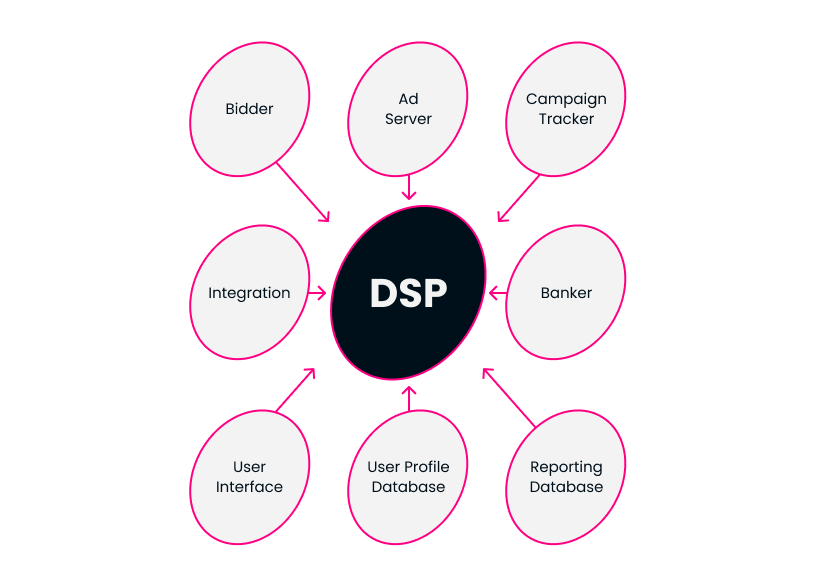
A fully functional DSP brings together several essential components that work in tandem to automate and optimize digital media buying:
The main component is the bidder engine, which evaluates and bids on available ad impressions in real time. Audience targeting tools are integrated with DMPs on third-party data providers to refine reach across segments. The campaign management dashboard enables advertisers to control budget, creative assets, and delivery across various channels. Reporting and analytics tools track performance and attribution, offering optimization insights. DSPs also connect with SSPs and ad exchanges to access premium inventory, while brand safety tools ensure ads appear in compliant and secure environments.
Why are DSPs Important?
Demand-side platforms have become fundamental to programmatic advertising by simplifying how advertisers access inventory, use data, and manage campaigns. Instead of negotiating directly with each publisher, advertisers can scale their efforts through a single interface.
DSPs automate buying across multiple ad formats, display, video, mobile, and more, while leveraging behavioral and contextual data for precise targeting. This automation results in better budget efficiency and faster execution. They also support real-time optimization, enabling advertisers to tweak bids, placements, or creatives instantly.
How does a Demand Side Platform Work?
A DSP operates by connecting to supply-side platforms (SSPs) and ad exchanges, which offer ad impressions in real-time, as users browse websites or open mobile apps. When an impression becomes available, the DSP evaluates it based on the advertiser’s targeting criteria, campaign goals, and budget. If the impression aligns with the campaign parameters, the DSP places a bid in real time.
Should the bid win, the ad is served instantly to the user. This process unfolds in milliseconds. Acting like a real-time decision engine, the DSP ensures advertisers compete for only the most relevant impressions, maximizing both efficiency and effectiveness.
When is a Demand Side Platform Used?
Advertisers turn to DSPs when they need to run scalable, data-driven campaigns across multiple channels and devices. Whether the goal is brand awareness or performance marketing, DSPs provide the tools to reach audiences based on behavioral signals, location data, or demographic profiles.
They are especially useful for campaigns that span display, video, mobile, and Digital Out-of-Home (DOOH), all from a unified platform. By automating bidding and media allocation, DSPs reduce the need for manual negotiations and direct publisher deals. They are also ideal for advertisers who require real-time insights and control to optimize spend and boost campaign outcomes efficiently.
Is Perion a Demand Side Platform?
Yes, Perion has a Demand-Side Platform (DSP) as part of our overall advertising technology solutions. Our advertising solutions include digital out-of-home (DOOH) advertising, among components such as DSP, an SSP, and an ad server. As such, Perion’s iHub platform can also be considered both as a DSP and SSP.
