


Observation in Market Research and Advertising Explained
Capturing the exact moment a consumer decides to buy during physical navigation is a persistent challenge for retail media and out-of -home advertising. While digital analytics provide clear tracking online, physical spaces often remain a data blind spot. This guide details how measuring real-world movement patterns, calculating visit-likelihood formulas, and deploying targeted observation techniques transform empty floor space into high-yield strategic assets for brands.
What is Observation in Market Research and Advertising?
Observation is the method employed in market research to study the behavior of individuals in interior spaces such as airports, transport stations, malls, stores, and similar. A selected group of people is observed as they navigate the space, and a factor indicating their likelihood of visiting a specific location is determined.
Unlike demographic studies that look at variables such as age or background, this method tracks the real-world route people take when they go shopping. It aims to calculate a “likelihood to visit” factor, which is a score that predicts how likely someone is to walk into a specific store.
What are the Key Components of Observation in Market Research?
There are three main components of effective observation in market research:
- The spatial perimeter baseline defines the exact boundaries of the environment being studied and maps every possible entry, exit, and transition point. Without a baseline, behavioral data lacks the necessary context to be actionable.
- Researchers identify subject navigation cohorts. Instead of viewing all shoppers as a monolith, observation categorizes individuals based on their movement patterns. For instance, power shoppers moving quickly towards a goal, or browsers with high dwell times.
- The model applies the propensity identification factor. This is the criterion used to signal that a subject is moving from a state of general navigation to a state of high intent. For example, using Perion’s retail media solutions at this stage allows you to engage consumers precisely when their purchase propensity is highest.
Why is Observation Important?
It provides ground-through data that bypasses the biases of traditional surveys. Surveys often suffer from stated-intent bias, where consumers report what they think they did or intended to do rather than their actual actions. Observation-based research allows brands to identify hot zones where consumer attention naturally peaks. Advertisers can then optimize the placement of high-value assets.
How does Observation Work?
The process works by tracking a subject’s physical coordinates and attentional orientation as they move through a space. An automated system records micro-behaviors and aggregates them into a heat map that reveals the highest-value paths within the environment.
For example, in an airport, observation might reveal that travelers moving toward Gate A have a 30% higher engagement with luxury displays than those moving toward Gate B.
How Do You Measure the Likelihood of a Visit?
To measure the probability of a consumer entering a store, you use the likelihood of a visit formula:
L= A*D/F
L (Likelihood) = The probability of a visit
A (Attentional alignment) = The degree to which the subject’s physical orientation is directed toward the target.
D (Dwell duration) = The amount of time spent in the consideration zone.
F(Environmental Friction) = Obstacles that might prevent a visit, such as heavy crowds, physical barriers, or long queues.
The formula allows you to identify if a lack of sales is due to poor attraction (low A), lack of interest (low D), or physical deterrents (high F).
Types of Observation in Market Research
Observation categories vary depending on the research goals.
- Covert observation involves monitoring subjects without their knowledge to ensure behavior is natural and untainted by the “Hawthorne Effect” (where people change behavior because they know they are being watched).
- Structured observation uses a specific checklist of behaviors to record, providing highly standardized data that is easy to quantify.
- Unstructured observation allows researchers to note anything they find relevant, which is used to discover unexpected consumer pain points.
- Participant observation involves the researcher joining the environment, acting as a shopper, to gain a first-hand perspective on the navigational experience.
Observation Techniques
Technological integration revolutionized traditional observation techniques. Advances such as physical tracking involve the use of sensors to map the literal path a customer takes. On the same line, eye-tracking technology can be used in controlled cohorts to see what parts of the ad or store shelf catch the user’s attention.
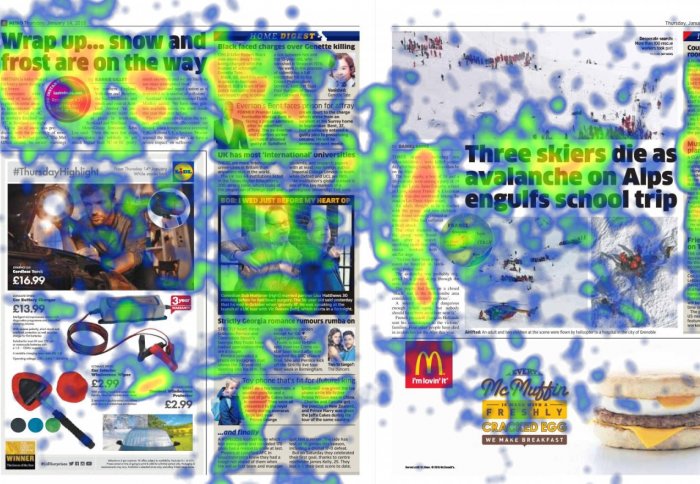
Example of a heat map on a web page using eye tracking technology. Source
Behavioral mapping is a method where researchers draw people’s actions onto a floor plan. This shows how the building’s design changes the way shoppers walk and move. For example, if a specific pillar consistently causes shoppers to turn away from a high-profile aisle, the map will reveal a friction point.
When is Observation Used?
This methodology is particularly effective for the optimization of large-scale commercial infrastructures such as duty-free zones in international airports. Observation is also used to assess the success of seasonal pop-up experiences. Because these installations are temporary, there is little time for trial and error; real-time observation allows for immediate adjustments to layout. It is used to validate advanced audience segmentation and targeting, where it compares the observation with predicted behavior and helps refine the programmatic advertising algorithms to mirror real-world movement.
Perion Case Study: Behavioral Mapping for Global Tourism Impact
To reignite travel interest among Canadian audiences, the Japan National Tourism Organization (JNTO) launched a programmatic Digital Out-of-Home (DOOH) campaign using Perion’s advertising platform. The campaign achieved 4 million impressions by targeting urban consumers within a high-impact, limited execution window.
The success of the campaign relied heavily on behavioral mapping to optimize ad delivery based on consumer movement and mindset:
- The campaign mapped consumer behavior to identify specific hot zones characterized by high foot traffic and an open consumer mindset.
- Behavioral mapping allowed JNTO to target locations where pedestrian movement slows down or involves waiting. This alignment ensured that immersive video and static creatives captured consumer attention precisely when individuals were primed for discovery and travel planning.
Observation Benefits in Advertising
The main benefit of observation in advertising is the elimination of stated-intent bias. Advertisers no longer have to guess if a consumer liked a display: they can see if the consumer stopped, looked, and entered. This leads to precision spatial monetization, where every square foot of a retail environment is valued based on its ability to drive specific behaviors.
Observation allows you to scale your strategy better. Once a brand understands the behavioral logic of its customers in one location, it can apply it to design more effective layouts and ad placements.
