


Outstream Video Ads: A Guide to Scaling Beyond Video Players
Traditional video ads force brands to compete for scarce, expensive inventory locked inside standalone video players like YouTube. Outstream video ads solve this by embedding video placements directly into standard text-based editorial content. This guide breaks down how outstream advertising works, the core formats available, and how you can use it to rapidly scale your video reach across premium publishers without the high costs of traditional video networks.
Outstream video advertising is the solution to this bottleneck, altering how publishers monetize inventory and how brands capture user attention across the open web. Discover how outstream video ads work in this article.
What is an Outstream Video Ad?
An outstream ad is a standalone video advertisement that integrates directly into non-video environments, such as editorial text, social media feeds, or mobile application interfaces. Unlike conventional video formats that rely on an existing stream of content, outstream ads create their own placement dynamically. These ads are designed to remain completely invisible until a user navigates to their specific location on a webpage.
The key element is viewport viewability. As a reader scrolls through a written article, the code detects when a specific container or paragraph break enters the visible screen area. At the exact moment, the editorial layout smoothly parts, the video container expands, and the creative begins to play automatically, usually with the sound muted by default to preserve a seamless user experience.
What Are Outstream Video Ad Types?
The most prevalent type is the in-read or in-article video ad, which embeds itself directly between paragraphs or editorial content. This format leverages the natural reading rhythm of the user, capitalizing on high-engagement zones where text is actively consumed.
Another common type is the in-banner video ad, which retrofits standard display banners with video capabilities, allowing brands to bid on highly available, traditional display placements while serving rich video assets.
For mobile-first experiences, the in-feed format integrates video ads directly into vertical content streams, perfectly mirroring the native scrolling behavior popularized by modern networks. For even a more natural transition, interstitial or overlay outstream ads appear during natural transition points within a user session, such as navigating between two articles.
Why are Outstream Video Ads Important?
The importance of outstream ads in any video marketing strategy lies in their ability to make video inventory more accessible for publishers. Before it, publishers running high-traffic blogs and portals were locked out of lucrative video budgets simply because they did not produce native video content. Outstream eliminates this barrier, turning premium text environments into highly monetizable real estate.
For advertisers, this format resolves the inventory problem that is prevalent in traditional video. Instead of competing aggressively for limited pre-roll slots on a handful of video-heavy platforms, brands can now place their video creatives inside highly authoritative editorial spaces.
It is opening opportunities for contextual alignment, and they are no longer restricted to running pre-roll ads; they can now embed their video message directly within a deep-dive written analysis.
How do Oustream Video Ads Work?
The process starts when a webpage loads. Rather than preloading heavy video assets that could slow down the site’s initial core web vitals, the outstream script sets up a lightweight listener. When the reader scrolls and the designated placement crosses the ad viewability threshold, typically defined by industry standards as fifty percent of the ad unit being visible on screen, the container expands dynamically.
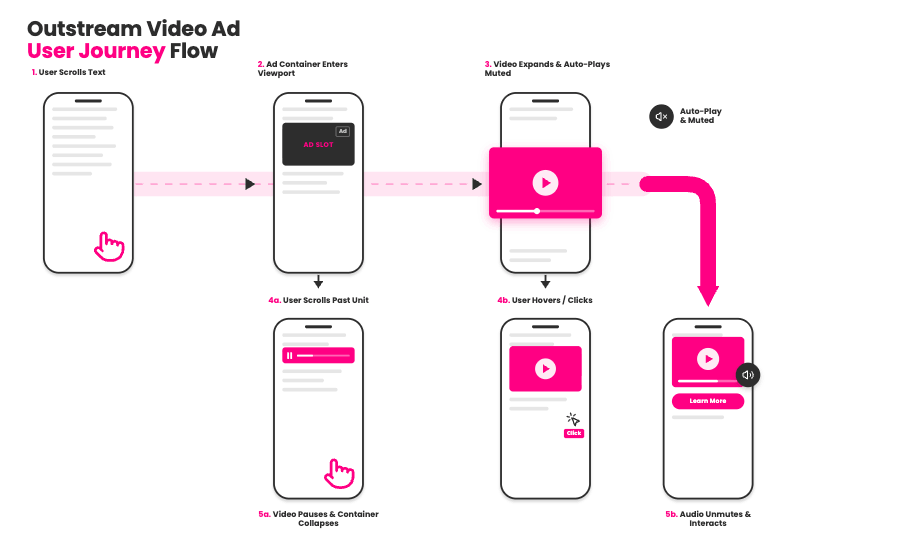
If the user strolls away, the video immediately freezes its playback state, saving bandwidth.
When To Use Outstream Video Ads
Outstream video ads should be used whenever an omni-channel campaign demands massive, high-quality scale not covered by standard video platforms. It is best suited for top-of-the-funnel awareness campaigns.
Outstream is highly effective when executing highly granular contextual targeting. These ads live inside text; semantic engines can analyze the surrounding paragraphs with precision, allowing advertisers to match their video creative to the exact nuance of the article being read.
Advantages and Disadvantages of Using Outstream Video Ads in Your Campaigns
The main benefit of outstream video is its inherently non-distruptive nature. Traditional in-stream ads force a user to wait through a forced countdown before they can access the content they actually came to see, which leads to consumer frustration. With outstream, the ad exists parallel to the content, and the user decides to engage or scroll past.
From a performance standpoint, outstream offers high viewability. The video pauses the moment it leaves the screen; therefore, advertisers are protected against paying for below-the-fold impressions.
Outstream’s most notable disadvantage is the reliance on a muted default state. Capturing the audience’s attention purely through visual cues requires more creativity. Any voiceover or dialogue can be lost on a scrolling user.
Also, because outstream ads don’t interrupt a primary video stream, they are easier to overlook.
Outstream vs In-stream Video Ads
While traditional in-stream ads rely heavily on existing video players and linear interruptions (like pre-roll or mid-roll slots) to capture active viewers, outstream video ads function autonomously. Outstream units expand dynamically between paragraph breaks or content streams within text-heavy editorial layouts, pausing when scrolled out of view to offer a less disruptive, highly scalable alternative for digital media buyers.
In-stream vs. outstream video ads
| Feature | In-Stream Video Ads | Outstream Video Ads |
| Player Requirement | Requires a native video player and host video content (e.g., YouTube, CTV). | Standalone; embeds directly into text layouts, feeds, or standard display slots. |
| User Experience | Disruptive: forces the user to wait or watch before/during primary content. | Non-disruptive; flows with the user’s reading or scrolling rhythm. |
| Default Audio State | Sound-on by default (inherits the audio state of the host content). | Muted by default; relies on visual hooks, captions, and user hover/click interaction. |
| Inventory & Scale | Highly constrained; limited strictly by the volume of native video content available. | Massively scalable; unlocks premium text-based editorial real estate across the open web. |
| Viewability Control | Runs regardless of user focus until skipped, closed, or completed. | Pauses instantly when scrolled past and collapses to protect viewability metrics. |
