


Consumers don’t move through a linear path to purchase anymore.
They discover products on their phones, see brands in the physical world, research online, and often purchase in-store—or the reverse—all within a single day. For marketers, that shift has fundamentally changed how media strategies are built.
The focus is no longer simply reaching audiences. It’s orchestrating engagement across physical and digital touchpoints to drive commerce outcomes.
New research from the Out of Home Advertising Association of America (OAAA) and Winterberry Group, supported by Perion, Moving Walls and Midnight Oil, shows that out-of-home (OOH) media is increasingly central to that effort.
The study, The Power of Proximity: OOH Media and Its Evolving Role in Connected Commerce, explores how enterprise marketers are integrating OOH into cross-channel commerce strategies, and how that role is expected to grow in the years ahead.
Connected commerce has become a strategic priority
As customer journeys become more fragmented, marketers are working to unify the way they deploy media across channels.
According to the research:
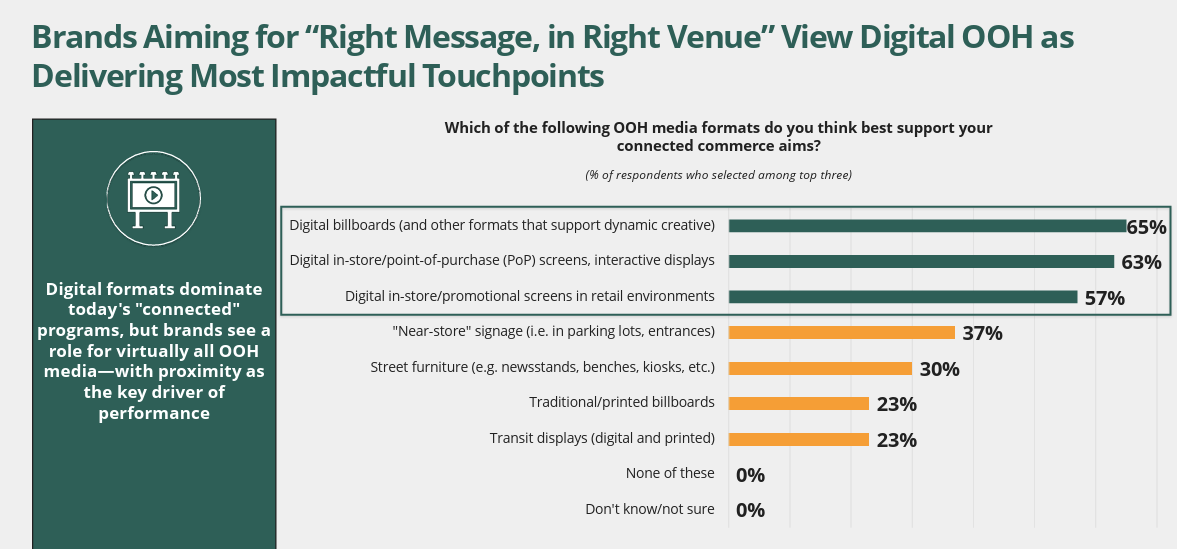
- 86% of marketers say they are extremely focused on building integrated cross-channel engagement strategies
- Nearly all respondents report incorporating OOH into commerce initiatives
- 98% say OOH plays either a core or supporting role in connected commerce programs
This shift reflects a broader evolution in marketing strategy. Brands are no longer planning campaigns channel by channel. Instead, they are coordinating content, timing, and messaging across media environments to influence behavior at every stage of the customer journey.
OOH plays a unique role in that ecosystem because it sits at the intersection of the physical and digital worlds, reaching consumers in the real-world environments where shopping decisions often begin.
OOH is moving from awareness channel to commerce driver
Historically, OOH has been associated primarily with brand awareness. But marketers increasingly see it as a channel capable of driving measurable outcomes across the purchase journey.
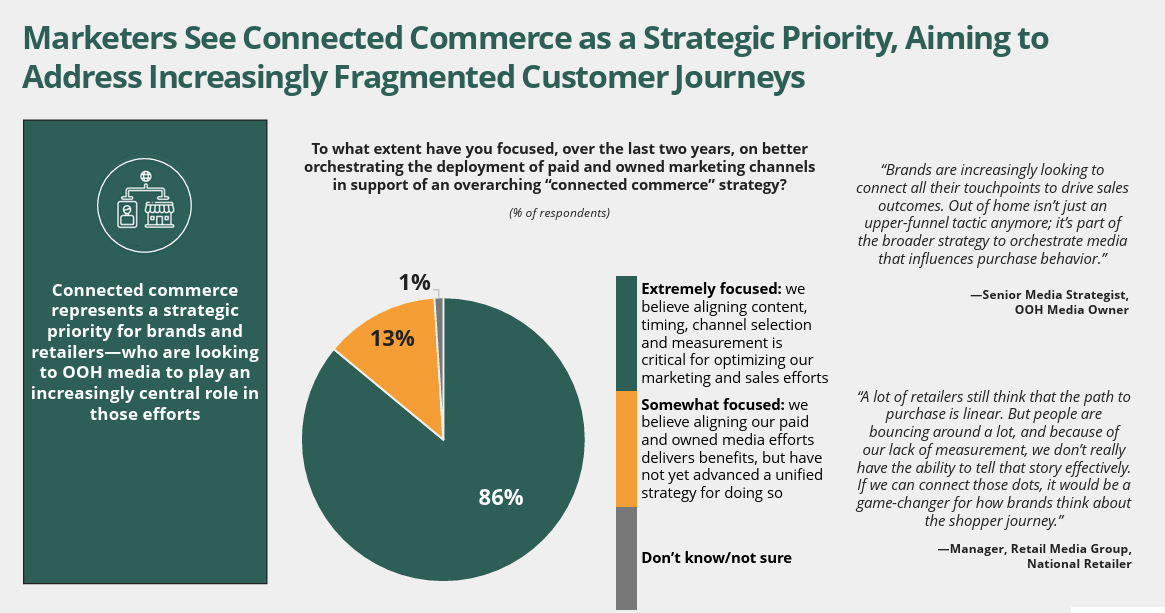
When asked about the role OOH plays in connected commerce programs, marketers most frequently cited:
- Cost-effective reach (52%)
- Driving traffic to retail partners (51%)
- Delivering consistent messaging across touchpoints (51%)
What’s notable is that these benefits span both brand building and performance objectives.
OOH can create broad awareness at scale while simultaneously reinforcing messaging closer to the point of purchase, especially when campaigns are coordinated with digital media, mobile engagement, or in-store messaging.
This ability to connect real-world presence with digital engagement is one reason marketers increasingly view OOH as a foundational element of modern commerce strategies.
Digital OOH is accelerating the shift toward connected activation
Technology is also expanding how brands activate OOH within connected commerce strategies.
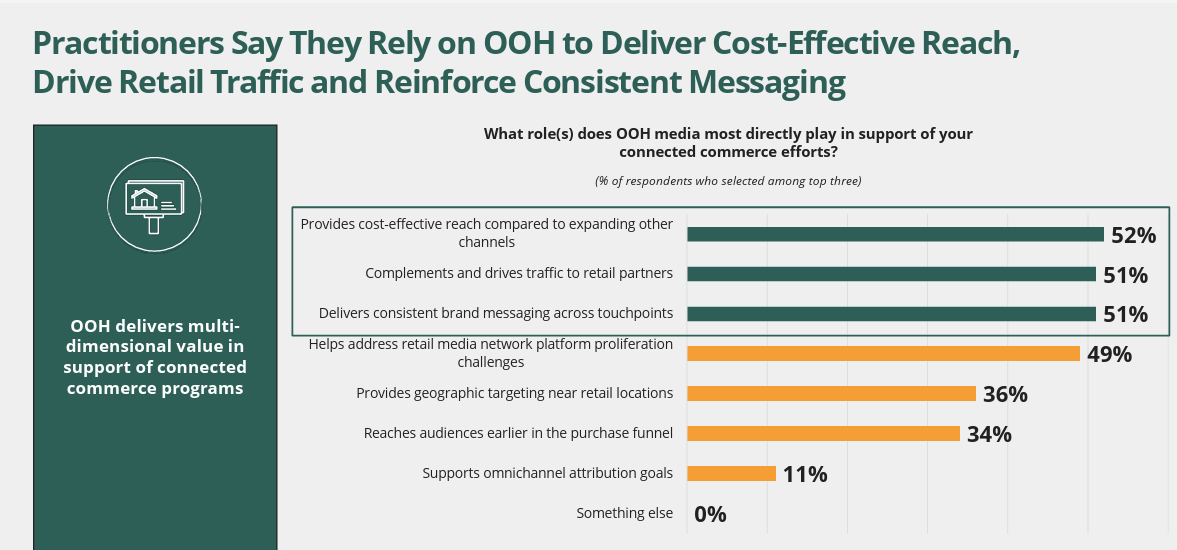
Digital formats now dominate integrated OOH programs. Marketers surveyed cited the following formats as most impactful:
- Digital billboards – 65%
- Digital in-store point-of-purchase screens – 63%
- Digital promotional displays – 57%
These formats offer capabilities that align closely with modern media buying:
- Dynamic creative updates
- Location-based targeting
- Real-time campaign optimization
- Programmatic activation
As a result, many brands are entering the channel through programmatic digital OOH, using automated buying platforms to test and scale campaigns more easily.
Over time, those programs often expand to include additional formats—such as transit or static placements—once marketers gain confidence in the channel’s measurable impact.
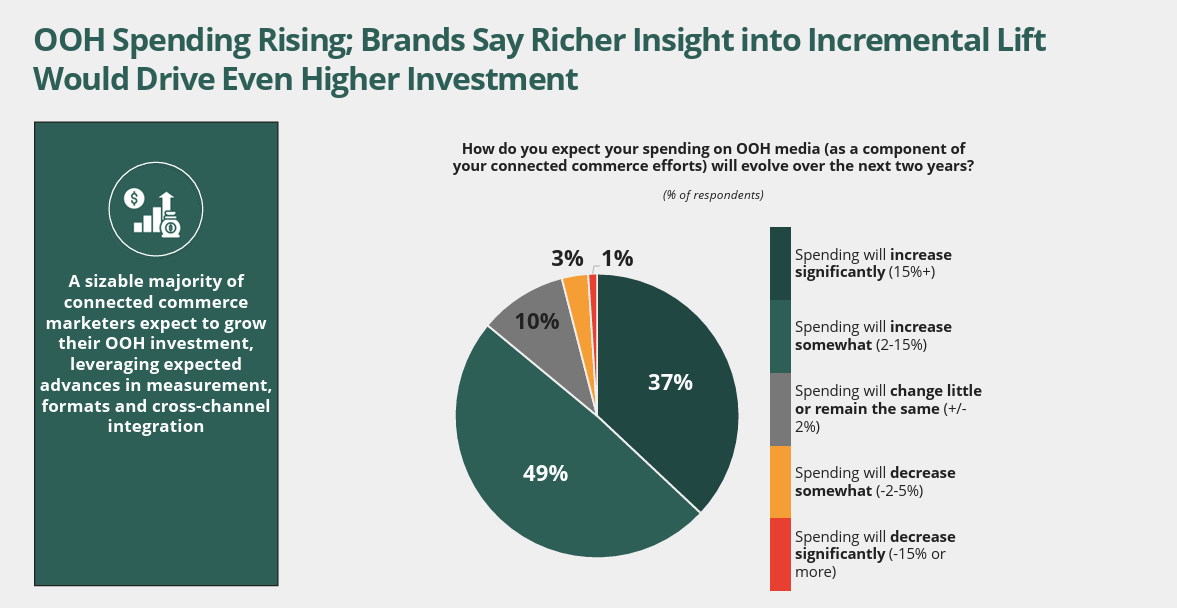
Investment in OOH is expected to grow
Perhaps the clearest signal of OOH’s growing role in commerce strategies is the investment outlook.
According to the research:
- 86% of marketers expect their OOH spending to increase over the next two years
- 37% anticipate spending growth of 15% or more
Marketers cite several factors driving that anticipated growth, including:
- Improved measurement and attribution capabilities (56%)
- Expansion of OOH formats and inventory (51%)
- Better understanding of OOH’s impact on commerce outcomes
As attribution models and cross-channel measurement continue to improve, brands are gaining greater visibility into how OOH contributes to discovery, engagement and purchase behavior.
That transparency is expected to unlock additional investment in the years ahead.
Orchestrating the future of connected commerce
The broader takeaway from the research is clear: the future of marketing will depend on how effectively brands orchestrate engagement across physical and digital environments.
OOH is uniquely positioned within that ecosystem.
It reaches consumers in real-world environments—between digital discovery and in-store purchase—where context, location and timing can strongly influence behavior.
As the industry continues to advance capabilities around measurement, addressability and programmatic activation, OOH is poised to play an even more important role in connected commerce strategies.
For marketers navigating increasingly complex customer journeys, the power of proximity may prove to be one of the most valuable assets in the modern media mix.
Download the full research report
To explore the full findings, insights and methodology behind this research, readers can download the report:
The Power of Proximity: OOH Media and Its Evolving Role in Connected Commerce
This research was conducted by the Out of Home Advertising Association of America (OAAA) and Winterberry Group, with support from Perion, Moving Walls and Midnight Oil.